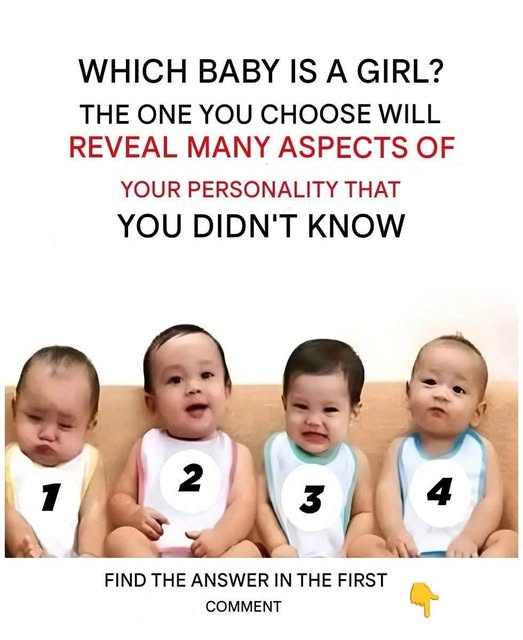
You’re shown four tiny faces, numbered 1 to 4. No context. No background story. No hints tucked between the lines. Just a simple, almost playful question appears on the screen:
“Which baby is a girl?”
At first glance, it feels effortless—like your mind has already started moving before you’ve consciously decided to think. Within a split second, your eyes settle on one face. Something about it feels “right.” You point. You choose. You commit. And then, just as quickly, you move on as if nothing meaningful just happened.
But here’s the interesting part most people never pause to consider:
What if that tiny, split-second decision wasn’t random at all?
What if it quietly reflected the way you perceive people, trust emotions, and instinctively respond to the world around you?
Because in moments like this, your brain isn’t performing logical analysis. It isn’t calculating probabilities or checking facts. Instead, it reacts—fast, intuitive, and deeply human. It pulls from subtle emotional cues, learned patterns, personal experiences, and even unconscious biases you didn’t know you were carrying.
The result isn’t a “correct answer,” because there isn’t one. All four babies are simply babies. The real meaning lies somewhere else entirely—in what caught your attention first, and why.
Did you notice softness before structure? Expression before symmetry? Calmness before energy? Or perhaps something more delicate that you couldn’t quite explain, but still felt drawn to?
These micro-reactions are fascinating because they often mirror how you move through relationships in real life. Not in a dramatic or obvious way—but in the quiet preferences you don’t always articulate. Who you naturally trust. Who you instinctively protect. Who you feel responsible for. Who you emotionally lean toward without realizing it.
This isn’t about labeling you as right or wrong. It’s about understanding that perception is personal—and often emotional before it becomes rational. Your attention has its own language, and it speaks before you do.
So when you pick “the girl,” you’re not solving a puzzle. You’re revealing a pattern: what your mind gently prioritizes when it has no rules to follow except instinct.
And that’s where it gets even more interesting.
If your choice was baby number 1, there’s a strong chance you carry a deeply sensitive and protective nature. You are naturally drawn toward what feels gentle, delicate, or quietly vulnerable. It’s not something you force—it’s automatic, like your heart leans forward before your thoughts catch up.
People around you often feel this without being able to explain it. Strangers may find themselves opening up to you more easily than they expected. Friends may rely on you emotionally without fully understanding why they trust you so much. There is something about your presence that feels safe, even calm, like you’re emotionally “tuned in” to what others are experiencing beneath the surface.
You tend to absorb emotions subtly, almost like a quiet radar picking up signals others miss. Before someone even says “I’m fine” or “I’m not okay,” you often already sense the truth sitting underneath the words.
This is not a loud kind of strength.
It’s a quiet one.
A steady one.
A kind of emotional awareness that doesn’t demand attention, but naturally earns trust.
In many ways, this is your understated superpower:
you notice deeply—and once you do, you rarely stop caring.