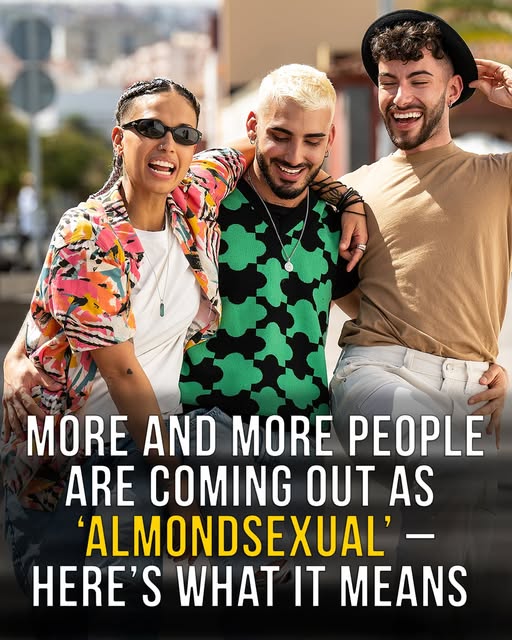
The word lands with an almost physical impact: almondsexual.
At first glance, it sounds unfamiliar—maybe even made up on the spot—but in the fast-moving language of the internet, it spreads quickly. One post leads to another, then suddenly it’s appearing in comment sections, identity threads, late-night confessions, and debates that range from curious to critical. Some people react with confusion or dismissal. Others react with recognition so immediate it surprises them. And in between those extremes are people quietly sitting with the word, turning it over in their minds like something fragile they don’t want to drop.
For some, new microlabels like this feel overwhelming—too many categories, too many definitions, too much slicing of something once thought to be simple. For others, though, these words don’t feel like excess. They feel like relief. A map drawn with finer lines. A language becoming more capable of describing what was always there but never properly spoken.
Almondsexuality, as those who use the term describe it, refers to a pattern of attraction that tends to lean strongly toward masculine and androgynous genders, while feminine attraction appears more faint, occasional, or situational. It is not just a statement of preference, but an attempt to describe rhythm—how desire shows up, how often it appears, and where it naturally tends to settle. For people who resonate with it, the label is not about restriction. It is about recognition. It says: this is the shape my attraction seems to take, even if it doesn’t fit neatly into older or broader categories.
To someone observing from the outside, it might seem like language is being stretched thinner and thinner, split into increasingly specific identities until it becomes difficult to keep track. That reaction is common, especially in a world already saturated with terminology for nearly every aspect of life. But what often gets missed in that reaction is the emotional history behind these words.
Microlabels rarely appear out of nowhere. They tend to emerge after long periods of uncertainty—after people have tried on existing terms and found that none of them quite hold. They come after years of asking, Why doesn’t this description feel like me? Why do I feel partly seen but not fully understood? In that sense, a word like almondsexual isn’t about creating complexity for its own sake. It’s about reducing internal chaos into something structured enough to hold.
And that is why these labels can feel so meaningful to those who adopt them. Not because they are fashionable or trendy, but because they offer precision where there was previously only approximation. They allow someone to say, with a kind of quiet certainty, this is close enough to how I experience myself that I can finally stop searching for a better fit—at least for now.
Of course, not everyone will use these terms. Not everyone will understand them, and not everyone needs to. Language for identity is never universal in the way mathematics is; it is personal, evolving, and sometimes temporary. But for the people who find themselves reflected in a word like almondsexual, that reflection can feel unexpectedly grounding.
It is not just a label. It is a moment of clarity in a long stretch of uncertainty—the feeling of finally seeing a shape where before there was only fog.