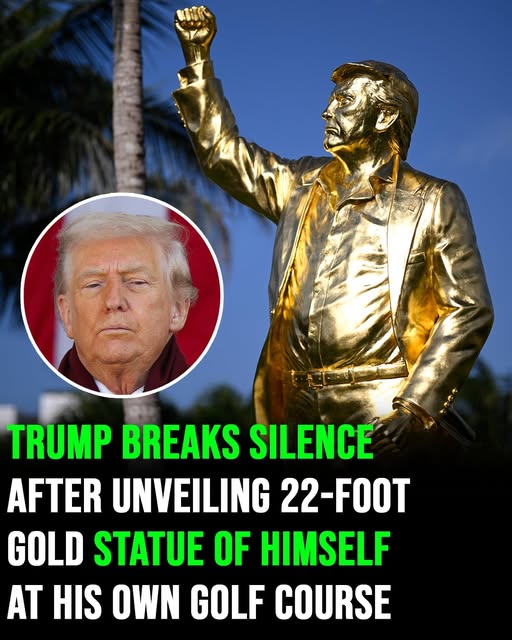
The ballroom fell into an almost sacred silence the moment the curtain dropped. Cameras froze. Conversations died mid-sentence. Before the crowd stood a towering, twenty-two-foot golden statue of Donald Trump — fist raised defiantly toward the sky, immortalized in the exact instant he survived an assassin’s bullet. Under the blazing lights, the monument shimmered like something pulled from myth, its polished surface reflecting awe, disbelief, admiration, and outrage all at once.
For some in attendance, it was more than art. It was survival cast in gold — a symbol of resilience, destiny, and what they believed was divine intervention. Others saw something far more unsettling: the elevation of a political figure into something dangerously close to worship. Within minutes of its unveiling, critics online were already calling it America’s “golden calf,” accusing supporters of crossing the line between loyalty and idolatry.
But inside Trump National Doral, supporters rejected those accusations entirely.
The unveiling ceremony had been carefully designed as both tribute and testimony. Funded through a mix of wealthy cryptocurrency investors and thousands of grassroots donors, the nearly $300,000 monument dominated the room like a modern political relic. Guests stood beneath its enormous shadow while flashes from cameras danced across the metallic surface. Some applauded. Some wiped away tears. Others whispered quietly among themselves, fully aware that the image before them would ignite a national firestorm.
Pastor Mark Burns, one of Trump’s most outspoken religious allies, took center stage to defend the statue from mounting criticism. Calling it a “celebration of life,” Burns insisted the monument was never intended to replace faith or glorify a man above God.
“Worship belongs to Jesus Christ alone,” he declared passionately to the audience. “This statue represents survival. It represents purpose. It represents the hand of God protecting a man who still has a mission to fulfill.”
Then came the moment many in the room had been waiting for.
As Burns lifted his phone to the microphone, Donald Trump himself joined the ceremony remotely. His voice echoed through the ballroom beneath the towering golden likeness. Trump did not deliver a fiery political speech. Instead, his words were surprisingly restrained — focused on gratitude, loyalty, faith, and love for the people who had supported him through every controversy, indictment, campaign battle, and near-tragedy.
“Thank you,” Trump said simply. “I’ll never forget the love you’ve shown me.”
Yet outside the walls of the celebration, the reaction was immediate and deeply divided.
To supporters, the statue captured a moment that changed history — a symbol of endurance in the face of violence and relentless opposition. To critics, however, the golden monument represented something darker: a political movement increasingly centered not just on ideas, but on devotion to a single man.
Social media exploded with comparisons to ancient empires, religious idols, and authoritarian imagery. Commentators debated whether the statue reflected patriotism, political theater, or personality cult symbolism. Even some conservatives expressed discomfort with the spectacle, questioning whether the imagery overshadowed the values supporters claimed to defend.
And perhaps that is why the statue has become more than just a monument.
It has become a mirror.
In the shimmering shadow of that towering golden figure, Americans are now confronting a deeper question — not simply what they believe about Donald Trump, but what they are willing to elevate, defend, and revere in an age where politics increasingly feels inseparable from identity, faith, and emotion itself.