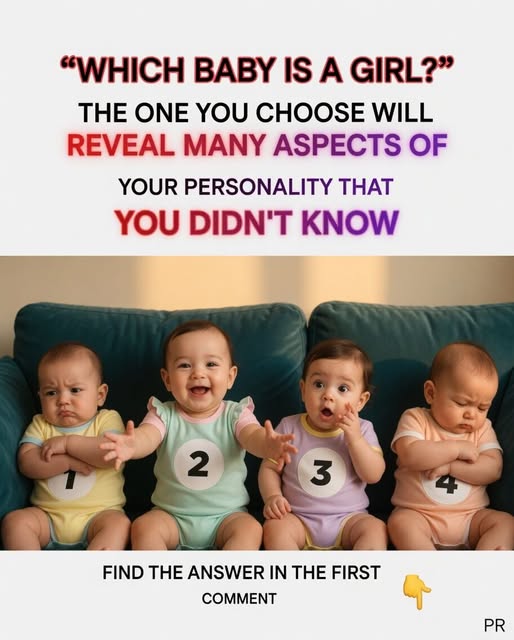
A single photo of four babies has managed to do something few things on the internet ever truly achieve: it has stopped millions of people in their tracks. At first glance, the image appears harmless, almost sweet—four innocent infants sitting side by side, each nearly identical, each impossible to truly know. Yet within seconds of seeing it, people everywhere begin making the same unexpected decision: choosing which baby they believe is “the girl.”
What should be a playful guessing game quickly transforms into something far more intense. Comment sections explode with confidence, arguments, and second thoughts. Some people instantly point to baby number two, convinced the soft smile and calm expression reveal a feminine energy. Others insist the answer is obvious for entirely different reasons. And then comes the unsettling part: after making their choice, many begin questioning themselves. Why did they pick that baby? What tiny detail convinced them? Was it logic, instinct, or something buried deeper in the subconscious?
The real twist is what makes this viral challenge impossible to forget—there is no confirmed answer that everyone can agree on. No scientific proof. No reliable method. Just millions of strangers desperately wanting their instinct to mean something. That uncertainty is exactly what keeps people hooked. The image becomes less about identifying a child and more about understanding ourselves.
What makes the challenge so fascinating is not the babies at all, but the silent mirror it holds up to every person staring at the screen. Faced with four nearly identical faces, the human mind immediately starts building stories from almost nothing. A tiny smile suddenly becomes kindness. A curious look becomes intelligence. A serious expression turns into confidence or sensitivity. In seconds, people create entire personalities from the smallest visual clues, believing their intuition is revealing hidden truth.
Baby number two has emerged online as the so-called “official answer,” praised by thousands as the face that radiates empathy, warmth, and emotional softness. People who choose that baby often feel strangely validated, as though their decision says something positive about who they are. Others feel disappointed when their instincts point elsewhere, almost as if they failed a secret psychological test they never agreed to take.
But beneath the surface of this viral phenomenon lies a far deeper reality. This challenge is not truly about gender at all—it is about human instinct, perception, and the powerful need to believe our choices reveal something meaningful about ourselves. It exposes how quickly we judge, how naturally we search for patterns, and how eager we are to turn feelings into facts. Even when the science behind the test is weak or meaningless, the emotional reaction it creates feels incredibly real.
That is why the photo continues spreading across social media at lightning speed. People are not sharing it because they care about being right. They share it because they want connection. They want reassurance that others see the world the same way they do. They want to compare instincts, defend their reasoning, and discover whether strangers think like them. In a world flooded with noise and distraction, this simple image offers something strangely personal: a fleeting moment where people pause long enough to wonder not just what they chose, but why they chose it in the first place.
And perhaps that is the most powerful part of all. The challenge reminds us that the human mind is constantly searching for meaning, even in places where none may exist. We want our instincts to tell a story. We want our choices to reflect hidden truths about our personality, emotions, and identity. So when millions of people stare at the same four babies and confidently make completely different decisions, the photo becomes more than a viral trend—it becomes proof of how deeply human beings crave understanding, validation, and the comforting belief that our intuition says something important about who we are.