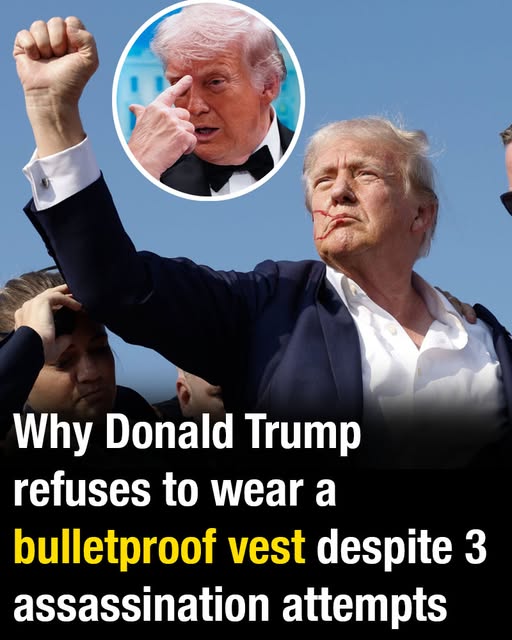
Trump could have died.
In a matter of seconds, the room transformed from routine to rupture. A sharp crack split the air—then another. Bullets tore through the space with terrifying precision. Trained agents moved on instinct, bodies shifting, shields forming, commands shouted over the rising chaos. One of them took the hit—a Secret Service agent dropping under the force of a round that could have ended a presidency. The President of the United States was seized and rushed out, the scene collapsing behind him into sirens, urgency, and controlled panic.
What followed should have been a moment of reckoning.
Days later, the story came into focus: the agent survived because of his vest. Kevlar—layered, tested, unglamorous—absorbed the violence of a “very powerful gun” fired at close range. It was the difference between tragedy and survival, between a headline and a funeral. Trump publicly acknowledged it, praising the agent’s courage, his resilience, and the quiet heroism embedded in protective gear that rarely gets attention until it saves a life.
And yet, when the conversation turned toward his own safety, the tone shifted.
Standing before cameras, Trump dismissed the idea of wearing a vest himself. Not angrily. Not even defensively. Casually. With a shrug wrapped in humor, he reduced life-saving armor to an issue of appearance—something bulky, something unbecoming. He joked that he couldn’t “handle looking 20 pounds heavier.” The room responded with laughter, the kind that fills awkward gaps and smooths over tension. But beneath that laughter sat a sobering contradiction: a man who had just witnessed the cost of vulnerability choosing, deliberately, to remain exposed.
This wasn’t an isolated incident. It was the third known threat against him in less than two years—a pattern that would make most leaders retreat behind thicker walls, tighter protocols, fewer risks. Instead, Trump leaned the other way. His refusal wasn’t just about comfort or style. It projected something more calculated: an image carefully maintained, a message sent without needing to be stated outright.
To critics, it reads as recklessness—ego overriding caution, optics outweighing reality. They see unnecessary risk, not just to himself but to those tasked with protecting him, who must compensate for a vulnerability he refuses to address. To supporters, however, the decision reinforces a different narrative. It signals defiance. Strength. A refusal to appear shielded, softened, or afraid. In their eyes, wearing visible protection might suggest weakness; rejecting it becomes a symbol of resilience.
But between those two interpretations lies something more complex.
On one side: a fallen agent, saved by technology designed for exactly this moment. On the other: a president choosing not to adopt that same protection, fully aware of what’s at stake. It’s a contrast that speaks to more than personal preference. It touches on the uneasy balance between power and perception, between leadership as it is lived and leadership as it is performed.
Because in the end, the danger wasn’t hypothetical. It was real, immediate, and inches away from altering history.
And the decision that followed wasn’t made in the heat of that moment—but after it, in full clarity, under the steady gaze of the world.