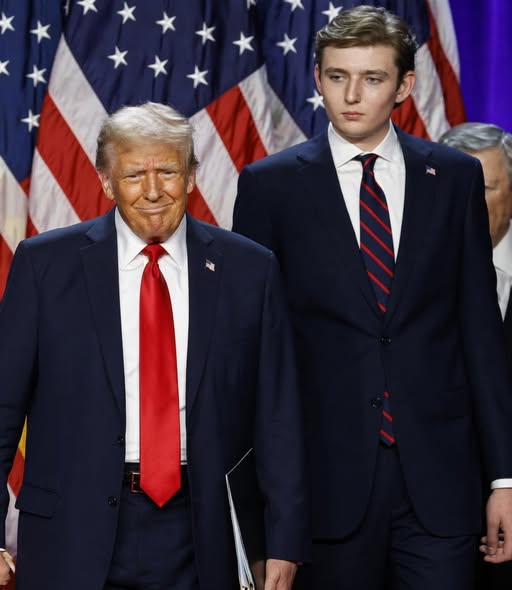
He was born into a world plated in gold and shadowed by sharpened steel—a life where privilege gleamed brightly, but danger, judgment, and spectacle lurked just beneath the surface. From the very beginning, the noise of the world was not a distant hum but a constant roar. Cameras followed his father like a second shadow. Headlines dissected his family with relentless precision. Strangers, emboldened by distance and anonymity, turned his mother into both icon and target. And at the center of it all stood a child—watching, absorbing, learning—not how to shine, but how to remain unseen.
Where others might have unraveled under such pressure, he was taught something entirely different: restraint. There were no public outbursts, no carefully staged moments of rebellion, no attempts to claim attention in a world already oversaturated with it. Instead, his upbringing was defined by quiet discipline. He learned early that silence could be a shield, that composure could be armor. While the world demanded spectacle, he mastered absence.
Behind closed doors, far from the chaos that defined his family’s public image, a different philosophy took root. His mother, shaped by her own encounters with scrutiny and judgment, chose protection over performance. She built a life for him that prioritized structure, privacy, and emotional distance from the storm outside. She resisted the pull to let him become a symbol, a talking point, or a character in an ongoing national drama. To her, he was not an extension of power or fame—he was simply a boy who deserved the space to grow without an audience.
In a culture obsessed with visibility, where every gesture can be magnified and every silence interpreted, his invisibility became its own quiet rebellion. While others in his orbit dominated headlines, he became defined by what he withheld. The world searched for glimpses, for meaning in small details—a photograph, a brief appearance, a passing expression—but found only fragments. A tall figure walking just behind his parents. A face composed, almost unreadable. A presence that seemed deliberate in its restraint.
But that restraint was not emptiness. It was intention. It was the product of a life lived under observation, where every movement carried weight and every misstep could echo far beyond its moment. He didn’t learn to perform for the world; he learned to move through it carefully, deliberately, almost invisibly. In a life most would find overwhelming, he found stillness.
And perhaps that is what makes his story so compelling—not what is seen, but what is not. Not the power he was born into, but the discipline he developed within it. Not the noise that surrounded him, but the silence he maintained despite it.
Whatever future he chooses—whether he steps into the arenas that defined his family or carves out a path entirely his own—it will not simply be shaped by legacy or expectation. It will be shaped by something quieter, something harder to measure: the ability to remain grounded while everything around him demanded spectacle. In a world that never stopped watching, he learned the rarest skill of all—how to live without needing to be seen.