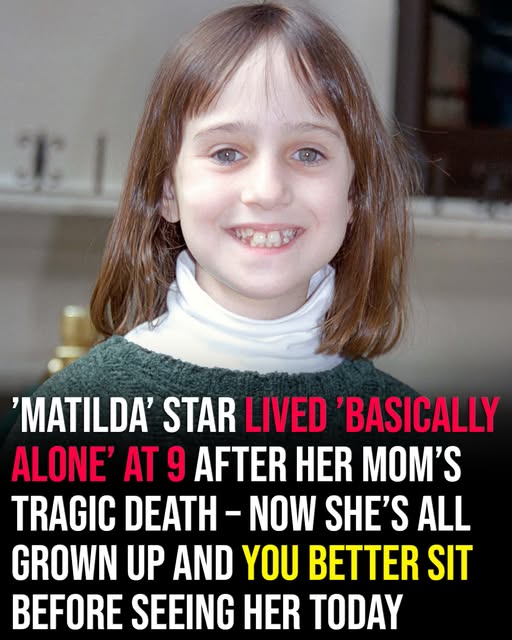
Mara Wilson was never meant to simply fade into the background. For a brief, dazzling moment in the 1990s, she was one of Hollywood’s most recognizable child stars — a bright, intelligent presence who could hold her own opposite legends like Robin Williams and Danny DeVito. Audiences watched her and saw effortless charm, timing beyond her years, and a rare emotional clarity that made characters feel real and deeply human. On screen, she wasn’t just “cute” — she was commanding.
But what the world saw as effortless success was happening alongside a childhood shaped by profound emotional weight. While she was filming beloved classics like Mrs. Doubtfire, Miracle on 34th Street, and Matilda, she was also dealing with something far heavier than any film script: the illness and eventual loss of her mother. That grief didn’t pause for takes or production schedules. It lived with her through every audition, every set, every smile expected from a child under constant public attention.
Hollywood, however, has never been kind to children once they begin to change.
As Mara grew older and entered adolescence, the industry’s attention shifted almost instantly. The same system that had once celebrated her presence began to quietly pull away. Puberty — a completely natural transition — became, in the eyes of casting directors and studios, a kind of rejection of her marketability. She no longer fit the narrow, heavily commercialized idea of what a “child star” should look like.
The message, though rarely spoken aloud, was unmistakable: she was no longer “the right kind” of cute. And in an industry that often values appearance over experience, that was enough for doors to start closing.
What makes her story particularly painful is not just the sudden slowdown in roles, but the emotional impact that followed. Like many child actors, she internalized the unspoken rules of the system she had grown up in — that worth could be measured in visibility, that love from the industry could disappear as quickly as it arrived, and that being seen was conditional. The exhaustion of early fame, combined with grief and mounting pressure, eventually pushed her away from acting altogether.
But that is not where her story ends — it is where it transforms.
Instead of disappearing, Mara Wilson rebuilt her identity on her own terms. She stepped away from Hollywood not as a failure, but as someone refusing to be defined by an industry that had already taken too much from her too early. She turned to writing, discovering a new kind of creative freedom — one that wasn’t dependent on auditions, appearance, or approval.
Through essays, storytelling, and public reflection, she began to speak openly about the realities of child stardom: the emotional toll, the unrealistic expectations, and the way young performers are often shaped and discarded by systems that prioritize profit over people. Her voice became sharp, honest, and unflinching — not the voice of a former child star trying to relive the past, but of an adult reclaiming authorship over her own narrative.
Today, Mara Wilson’s impact doesn’t come from box office numbers or red carpets. It comes from something more lasting: clarity, honesty, and the courage to name what others in the industry often stay silent about. Her story is not one of disappearance, but of evolution — from being watched, to finally being heard on her own terms.