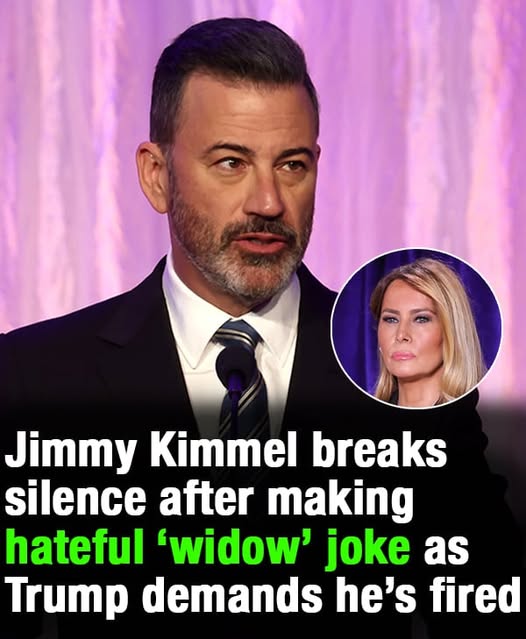
The moment could hardly have been more explosive. Just forty-eight hours after Jimmy Kimmel delivered a biting monologue line—quipping that Melania Trump carried “the glow of an expectant widow”—news broke that a gunman had allegedly attempted to assassinate Donald Trump. What might have otherwise faded into the churn of late-night satire suddenly took on a far darker weight. The reaction was immediate and fierce. Outrage rippled across political and media circles. Trump himself lashed out, demanding Kimmel’s removal from television. Melania, typically reserved in public disputes, broke her silence. And under the glare of a national spotlight, Kimmel was left to respond live, addressing a controversy that had escalated far beyond a punchline.
When he finally spoke, Kimmel struck a careful, uneasy balance—part defense, part reflection. He characterized the now-infamous remark as a familiar kind of late-night jab, rooted in the long tradition of poking fun at high-profile couples with significant age gaps. It was, he argued, never intended as anything resembling a wish for harm. He underscored his consistent criticism of political violence and his public stance against gun culture, attempting to draw a clear line between satire and real-world consequences. Yet even as he clarified his intent, Kimmel stopped short of issuing a full retreat. He pivoted, suggesting that if the country is serious about lowering the temperature of its rhetoric, the scrutiny cannot be one-sided—that it must also include Donald Trump’s own history of incendiary language.
What unfolded was more than a feud between a comedian and a former president; it became a revealing snapshot of a nation on edge. Humor, politics, and the very real fear of violence collided in a way that made it difficult to separate one from the other. For Melania Trump, the comment did not exist in a vacuum—it echoed against the backdrop of a deeply unsettling security threat and reports of a manifesto that named her husband as a target. For Trump’s supporters, the joke symbolized what they see as a culture of media hostility and disregard. For Kimmel’s audience and defenders, it raised urgent questions about the limits of satire and the importance of protecting free expression, even when it provokes discomfort.
Caught between these opposing interpretations is a broader public, increasingly uneasy and unsure where the boundaries lie. The phrase “just a joke” feels less like a harmless defense and more like a point of contention in a society where words can carry unpredictable consequences. In this charged environment, even a late-night monologue line can ignite a national debate—one that forces Americans to confront how humor functions in a time when reality itself often feels just as volatile as the punchlines meant to comment on it.