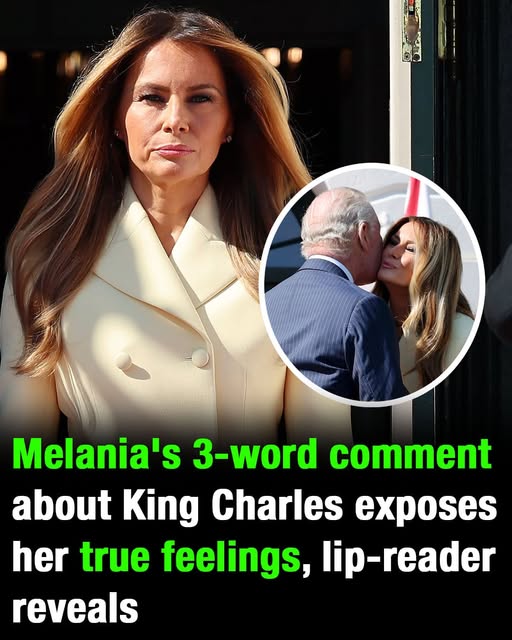
The cameras caught everything—and, in a way, nothing at all.
A fleeting smile exchanged at just the wrong second. A quiet word lost beneath the hum of protocol. A bow that never quite happened. A hand that hovered, then withdrew. From these fragments—ordinary in isolation, electric in aggregation—a routine state visit between Donald Trump and King Charles III was suddenly recast as something far more speculative: a battlefield of interpretation.
Was it warmth carefully extended across political divides? Was it calculation, each gesture measured against the invisible ledger of diplomacy? Or was it something more fragile and less definable—mutual need, carefully disguised as composure?
As analysts replayed the footage in slow motion and commentators dissected every angle, the visit became less about policy and more about posture. Even Melania Trump’s beekeeping initiative, quietly presented on the margins of the White House grounds, was pulled into the symbolic orbit of the day. What might have been a simple environmental gesture instead appeared as curated softness—an image of cultivation, patience, and control, wrapped in the language of ecological concern.
King Charles III, long associated with environmental advocacy himself, moved through the moment with practiced ease. His tone remained light, his expressions carefully open, his conversational rhythm adapted to the rhythm of the room. In that exchange of polite remarks and restrained smiles, he did what seasoned royals are trained to do: he softened edges without drawing attention to the act of softening them.
Together, these parallel displays created an unusual symmetry—two figures fluent in symbolism, each comfortable in the theater of public meaning. Their interaction, later parsed by lip-readers, body-language experts, and political commentators alike, revealed not hidden alliances or secret disagreements, but something more understated: a shared competence in maintaining public composure under scrutiny.
What stood out most, perhaps, was not what was said, but what was carefully not allowed to break. The absence of bows was noted, yet not explained. The distance between them was observed, yet never remarked upon directly. The tone remained consistently formal, yet intermittently familiar—like a conversation rehearsed just enough to survive unpredictability.
In modern diplomacy, tradition and optics no longer sit comfortably apart; they overlap, collide, and sometimes disguise each other entirely. Every gesture becomes a potential headline. Every pause becomes a theory. And yet, within that noise, something quieter unfolded here.
Not resolution. Not rupture. But continuity.
A controlled vulnerability held steady long enough to pass as stability. A carefully maintained mood that resisted escalation, even as interpretation threatened to pull it in every direction. In a world eager to overread every glance and amplify every silence, the most significant outcome may have been the simplest one: nothing cracked.
And in that restraint, cooperation—however tentative, however temporary—remained not dramatic, but possible.