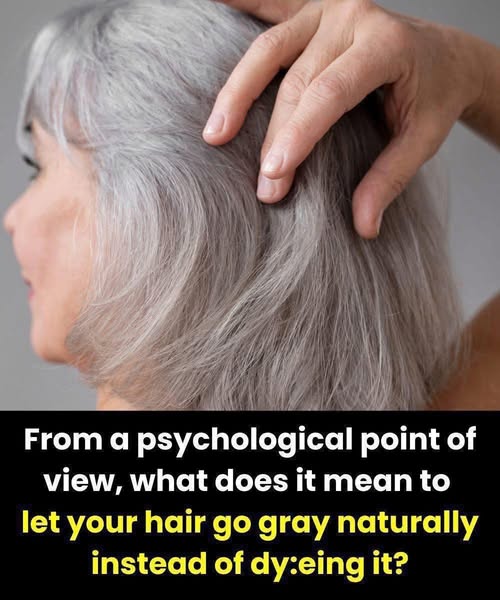
Letting her hair grow out into gray often looks, at first glance, like a simple personal choice—quiet, harmless, almost effortless. But in reality, it rarely stays that way in the eyes of others. Something subtle shifts in the room. Conversations pause for half a second longer than usual. Friends begin to offer “concern” wrapped in polite language. Strangers glance twice, as if trying to confirm what they think they saw. Even partners, who once spoke freely about everything else, sometimes hesitate—searching for words that don’t sound like judgment, yet betray it anyway.
Because what is really being noticed is not just hair color. It is the quiet refusal to participate in a system most people never question out loud.
This isn’t about beauty in the superficial sense. It is about what gray hair disrupts underneath it: the collective denial of time, the cultural worship of youth, and the silent expectation that appearance should always be managed, maintained, and controlled. Her decision—whether intentional or simply natural—collides with all of that at once. And in doing so, it exposes how fragile those assumptions actually are.
Gray hair unsettles people because it breaks an unspoken agreement. A social pact that says: we will all pretend aging is optional, reversible, or at least concealable. We will treat time as something that can be negotiated if we try hard enough, if we buy enough products, if we stay disciplined enough. And most importantly, we will not draw too much attention to the fact that none of us can actually win that negotiation.
When a woman stops participating in that illusion, she becomes something she never explicitly asked to be—a mirror. Not because she is doing anything dramatic, but precisely because she is not. Her presence reflects back what others work so hard to soften, filter, and delay: that control has limits, that youth is temporary, and that aging is not a mistake to correct but a reality to inhabit.
The discomfort she triggers is rarely honest on the surface. People do not usually say, “Your gray hair makes me think about my own mortality,” or “It reminds me that time is moving whether I approve or not.” Instead, the reaction is redirected into safer language—“Are you sure you don’t want to color it?” or “You’d look so much younger if…”—phrases that disguise existential discomfort as aesthetic advice.
At the same time, her choice quietly challenges a much older expectation placed on women in particular: the demand to remain perpetually polished, agreeable, and visually “acceptable” at every stage of life. There is an unspoken script that says aging should be managed discreetly, softened carefully, and never allowed to interrupt the illusion of timelessness. To step outside that script is not just a style decision—it is a refusal.
And that refusal carries weight.
By allowing her natural gray to show, she signals a shift in allegiance—from external validation to internal alignment. From performing palatability to choosing honesty. From being seen in a way that comforts others, to being seen in a way that is true. Her hair becomes less about appearance and more about stance.
It is not an apology. It is not a surrender. It is a boundary—quiet but unmistakable: I will not disappear to make you more comfortable with time.
And that is why it draws attention. Not because it is loud, but because it is honest in a world that often prefers illusion over reality.