Some loves are not gentle. They are not quiet or convenient or neatly wrapped in perfect memories. Some loves are forged in fire—tested in heat, scarred by loss, and still somehow unbroken.
Mine was born in smoke.
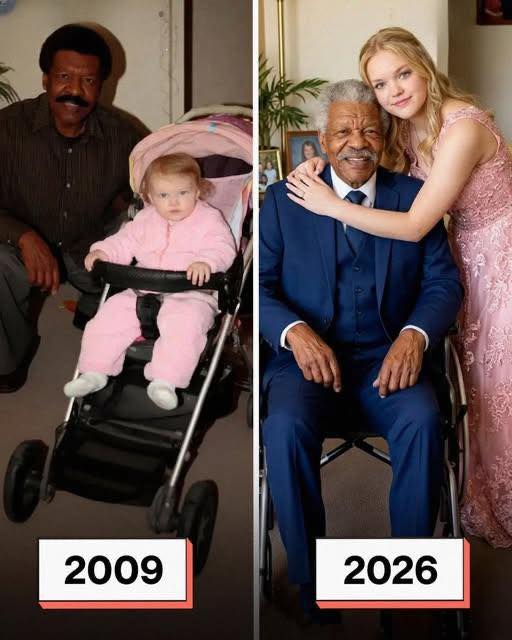
I was only a baby when it happened—the night everything changed. My grandfather didn’t think twice when the fire took hold of the house. He ran in anyway. Through collapsing heat and blinding smoke, he found me, wrapped his arms around me, and carried me out like I was the only thing that mattered in a world falling apart. I can’t remember the flames, but I’ve spent my entire life remembering him: coughing, shaken, refusing to let go even after we were safe. That night, he lost more than most people lose in a lifetime—his home, his child, the life he had built piece by piece. But somehow, even after all of that, he didn’t let grief define him. He rebuilt. Not for himself at first—but for me.
Years passed, and what he built was not a perfect life, but a real one. A life stitched together with uneven seams and quiet determination. He learned how to care for me in ways no one ever taught him—how to fix my hair in crooked braids that never quite matched, how to burn dinner and laugh about it anyway, how to sit in the front row of every school recital like I was the greatest thing he had ever seen. Every sacrifice he made was silent, but it echoed everywhere in my life. Even when his hands trembled with age, even when exhaustion lived in his bones, he still showed up. Always.
Then came the stroke. It took pieces of him—his balance, his independence, parts of the man he used to be. It changed the way he moved through the world, but it never changed the way he loved me in it. If anything, it made that love more visible. More deliberate. More sacred. He learned to live within new limits, but he never accepted limits on his devotion. Every visit, every smile, every effort to stay present became its own kind of victory over everything he had lost.
And then came prom night.
I remember the noise first—the music, the laughter, the kind of teenage chaos that fills a gym like weather. I remember the nervousness too, the feeling that I didn’t quite belong in any of it. And then the doors opened.
He rolled in slowly in his wheelchair.
At first, there were whispers. A few confused glances. A few cruel laughs that didn’t understand what they were seeing. But then something shifted. Because when people recognized him—not just as someone in a wheelchair, but as him—the atmosphere changed. The noise softened. One by one, those whispers died out, replaced by something heavier: understanding. Respect. Awe.
He didn’t come to interrupt my night. He came to complete it.
When he reached me, he looked up like he always had—like I was still that child he once carried through fire. And in that moment, everything else faded. The gym, the music, the crowd—it all blurred into something distant and unimportant.
Our slow dance wasn’t about rhythm or perfection. It was about everything we had survived without ever saying it out loud. It was smoke and sirens, hospital hallways and recovery rooms. It was scraped knees and school mornings, scholarship letters and late-night talks when neither of us had the words but stayed anyway. It was a lifetime compressed into a single song, his hands steadying me the way they always had—long before he needed a wheelchair to reach me.
And in that dance, I understood something I had spent my whole life learning without realizing it:
Some people talk about unconditional love like it’s a dream.
I watched it roll across a gym floor and hold me close.