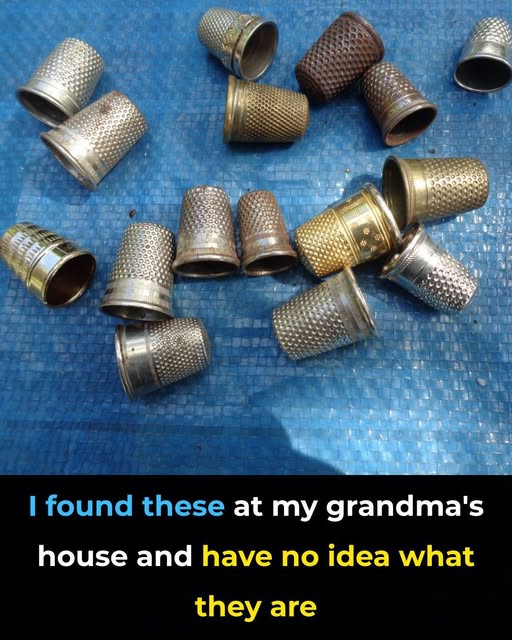
Thimbles have guarded human hands for thousands of years—quietly, faithfully, almost invisibly. Most people never notice them, never pause to consider the small, domed shield perched on a fingertip. But behind that modest curve of metal lies a story shaped by pain, precision, and power. It is a story stitched through centuries—one where survival, status, and skill are bound together in something no larger than the tip of a finger.
Long before thimbles became the delicate curiosities tucked into sewing kits, they were instruments of necessity. In ancient workshops across China and Rome, they were as essential as thread itself. Sewing was not a pastime; it was protection against the cold, a defense against exposure, a way to hold life together—literally. Every garment carried urgency, and every stitch risked injury. Needles pierced skin as easily as cloth. Without protection, hands hardened, split, and bled.
Early thimbles—crafted from bone, bronze, leather, or even ivory—were born from this struggle. They were not decorative; they were survival tools. A household without one was a household at risk. Clothing was shelter, and the act of making it demanded endurance. In this world, a thimble was not small—it was essential. It stood between fragile skin and the relentless push of steel through fabric.
As centuries passed, something remarkable happened. This humble tool, forged in necessity, began to transform. By the sixteenth and seventeenth centuries, thimbles had taken on a second life—not just as protection, but as expression. In the courts and drawing rooms of Europe, they gleamed.
Silver replaced bronze. Gold replaced bone. Artisans engraved intricate patterns into their surfaces, set tiny gemstones into their crowns, and turned them into miniature masterpieces. What had once been purely functional became deeply personal. A thimble could signal refinement, wealth, even identity. It could be gifted, inherited, cherished.
Among the elite, a thimble was no longer just used—it was displayed. It told a story about the hands that held it: hands that might never need to sew for survival, yet still carried the symbol of that ancient labor. Mothers passed them down to daughters, not just as tools, but as heirlooms—quiet vessels of memory, skill, and tradition.
And yet, beneath the shine and ornament, the purpose never changed.
Even today, thimbles remain what they have always been: protectors. Steel ones bear the force of heavy-duty work. Leather thimbles mold gently to the hand, offering comfort and control. Plastic versions, light and simple, serve quick repairs in modern homes. Their forms have evolved, but their mission is unchanged—to steady the hand, to guide the needle, to shield the maker.
Look closely at any thimble, and you’ll see it: the tiny dents, the worn edges, the subtle scratches. Each mark is a record of effort, of patience, of creation. It is a history written not in ink, but in pressure and repetition.
Because thimbles were never just tools.
They are the quiet guardians of human making—the small, uncelebrated armor that helped clothe generations, protect families, and transform raw fabric into something that could endure. In their silence, they carry a truth we often overlook: that even the smallest objects can hold the weight of survival, and the legacy of human hands.