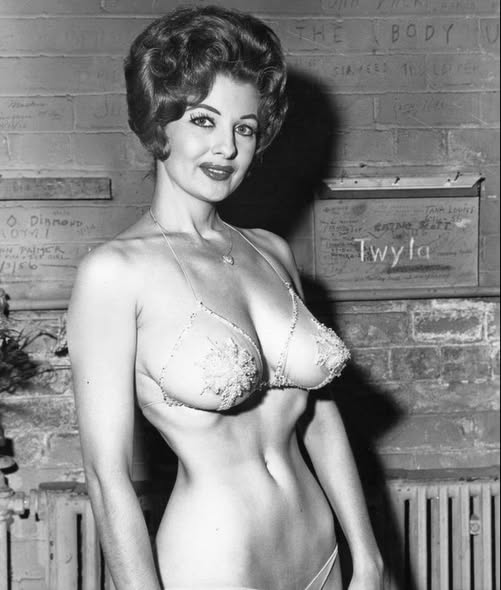
With a name that sounded less like a person and more like a force of nature, Tempest Storm didn’t quietly carve out a place in history—she stormed it. Her life was not a gentle ascent but a series of eruptions, each one shattering expectations, defying limits, and daring the world to look away. She wasn’t shaped by her past; she set it on fire and walked forward through the smoke.
Long before the spotlight found her, she was Annie Blanche Banks, a girl born into the unforgiving margins of rural Georgia. Poverty pressed in. Abuse lingered. The future looked narrow and predetermined. But even then, there was something unyielding in her—a refusal to accept that this was all she would ever be. As a runaway teen bride, she escaped with little more than instinct and a stubborn, almost dangerous belief that she was destined for something larger. That belief would become her compass.
When Hollywood finally opened its doors—half invitation, half test—it offered her a choice of identities: “Sunny Day” or “Tempest Storm.” One promised comfort, softness, a kind of forgettable charm. The other crackled with tension, power, and risk. She chose the storm without hesitation, as if she already knew that her life would never be about playing it safe.
Onstage, Tempest didn’t simply perform—she transformed. In an era that often reduced women to spectacle, she elevated burlesque into something deliberate and commanding. Every movement was measured, every reveal controlled, every glance intentional. There was elegance in her presence, a near-regal authority that made audiences lean in not just with desire, but with awe. She wasn’t giving herself away; she was orchestrating an experience. In her hands, striptease became less about exposure and more about power—the art of deciding what to show, when, and on whose terms.
Offstage, she lived with a discipline that sharply contrasted the fantasy she projected. She rejected the excesses that consumed so many around her—no alcohol, no shortcuts, no surgical reinventions. She believed her allure came not from illusion, but from authenticity, from a body and spirit honed by intention rather than artifice. In an industry built on reinvention, she chose consistency, and in doing so, became something far rarer: real.
Her personal life was no less fearless. She loved with the same intensity she brought to the stage—boldly, unapologetically, and without regard for consequence. Rumors and headlines linked her to icons like Elvis Presley, while her marriage to Herb Jeffries broke barriers that society wasn’t ready to see fall. Their interracial union came at a cost—lost opportunities, closed doors, whispered judgments—but she never bent under the weight of it. For Tempest Storm, conviction was never negotiable.
And while time quietly ushered many of her contemporaries offstage, she refused to disappear. Decade after decade, she returned to the spotlight, not as a relic, but as a living testament to endurance. Performing well into her eighties, she became a bridge between eras—a direct line connecting the golden age of burlesque to its modern revival. Where others saw age as an ending, she treated it as evolution.
In the end, Tempest Storm’s legacy is not just one of glamour, though she had that in abundance. It is a legacy of defiance. Of rewriting the rules in a world that tried to write her off. Of proving that owning your image, your body, your story—fully and unapologetically—is not just an act of self-expression, but an act of rebellion.
She didn’t just captivate audiences. She challenged them. And in doing so, she turned her life into something far more powerful than performance.
She made it a statement.