Minneapolis woke up to blood on the snow — and a story that refuses to make sense.
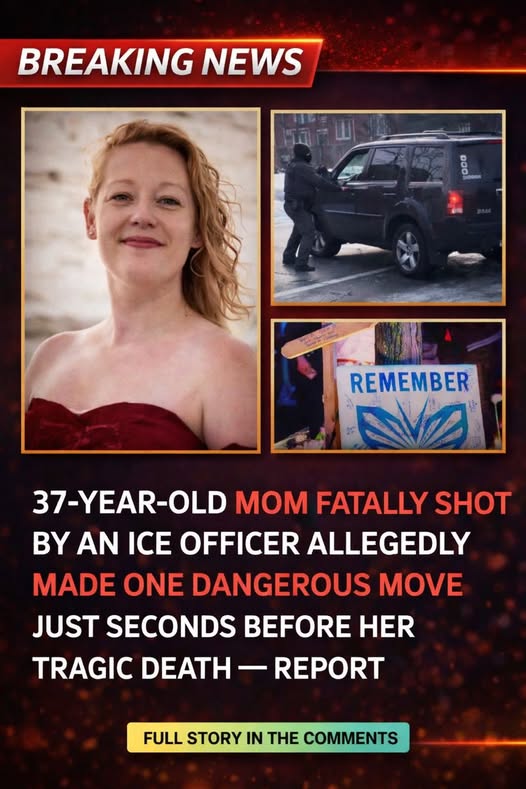
By dawn, the streets of Powderhorn Park were sealed off with yellow tape and disbelief. Renee Nicole Good, a mother, a poet, and the woman neighbors called “the heart of the block,” lay dead beside her SUV, her blood melting into the frost. A federal ICE agent pulled the trigger. By morning, Washington had already chosen its version of events.
South Dakota Governor Kristi Noem called it terrorism.
Neighbors called it murder.
And in between those two words lies a city unraveling.
Renee’s death is no longer just a tragedy — it’s a national confrontation between two clashing realities. Federal officials insist she “weaponized” her SUV and left an ICE officer with no choice but to fire. But those who knew her tell a story that could not be more different: a soft-spoken artist, a mother of three, a woman who read poetry under string lights at local cafés, who played guitar at community fundraisers, and who believed in solving every problem with patience, never anger.
Now her name has become a headline, her final moments dissected in viral clips and political debates. The video — shaky, harrowing, undeniable — shows a flurry of gunfire, a stopped vehicle, and agents who appear uninjured. It does not show the terror that led her to that moment, nor the child who will grow up asking why his mother’s kindness wasn’t enough to save her.
In the days since the shooting, Powderhorn Park has transformed into something between a shrine and a battleground. Vigils bloom like frostbite — candles in paper cups, handwritten prayers on damp cardboard, songs that trail off into sobs. Strangers kneel beside neighbors, sharing silence where words fail. Renee’s wife has been seen clutching their son’s mittened hand, her face hollow with shock. Her mother, her voice trembling through the cold, told reporters, “She wrote poems about forgiveness. I just don’t know how to find it now.”
Meanwhile, in Washington, podiums and politics have taken over the narrative. Officials cite protocols, classified briefings, and “credible threats.” Commentators trade outrage for ratings. But on the streets where Renee once walked her dog and waved to neighbors from her porch, the grief is real, raw, and unspun. Here, her story isn’t a soundbite — it’s a wound.
Community leaders have demanded the release of every bodycam frame, every dispatch call, every second of footage that might explain what truly happened on that frozen street. Civil rights attorneys call it a test of America’s conscience — whether a Black queer mother’s life can ever be weighed the same as a federal officer’s fear.
For now, the snow keeps falling over the place where Renee fell.
Children leave hand-drawn hearts in the shape of her initials. Poets recite her verses in the park she loved, their breath turning to mist in the cold. And across the city, a single demand echoes like a drumbeat through the winter air:
Tell the truth. Show the video. Say her name.
Renee Nicole Good’s life — defined by words, music, and compassion — ended in gunfire. But her story, carried by a grieving city, is still being written.