Melania Trump Stepped Off Marine One — and the World Lost Its Mind
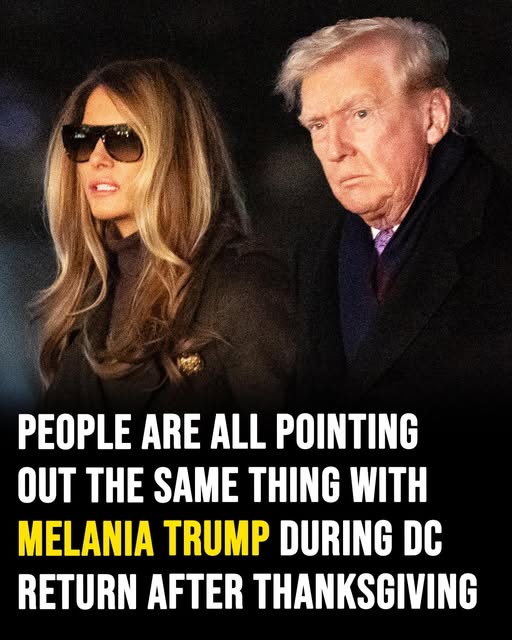
It was a quiet night in Washington, D.C., the kind of late hour when the city’s usual bustle is replaced by a hollow, expectant calm. Marine One touched down, and the First Lady emerged, moving with the careful, measured steps of someone who had walked this path a thousand times. But unlike the usual flash of cameras and applause, there was silence — or at least, the kind of silence that feels loaded with tension.
Then the lenses zoomed in. And all hell broke loose.
It wasn’t the way she held herself, nor a stray comment caught on a mic. It wasn’t a frown, a smirk, or an imperceptible twitch. It was what she didn’t take off: the oversized, opaque sunglasses shielding her eyes from the unrelenting glare of spotlights, night or day. In those dark lenses, millions of people saw what they wanted to see — or thought they did.
Within minutes, social media erupted. Memes circulated faster than the actual footage, hashtags flared, and every angle, every shadow, every slight movement became a point of speculation. Some doubted it was even Melania herself. Others mocked the very act of wearing glasses at night. Political pundits dissected it as if her eyewear were an ideology, a message, a statement against the world. The late-night footage of the First Lady descending from Marine One became a digital Rorschach test for a deeply divided nation.
To some observers, it was simple: a tired woman shielding puffy eyes, skipped makeup, or recovering from a migraine after hours under harsh lights. Perhaps it was a quiet act of self-preservation — a way to carry herself with dignity while hiding human vulnerability. To others, the image became symbolic: a wall between the public and a First Lady who never quite seemed to belong in the role thrust upon her. Every reflection, every glint of dark plastic, was read as a coded message of distance, aloofness, or intentional secrecy.
And then came the conspiracies. Predictably, the internet conjured body doubles, doppelgängers, “fake Melania” theories — everything from CGI manipulations to clandestine replacement agents flown in for optics. The same people who once debated the positioning of Christmas wreaths or the style of a state dinner centerpiece now debated the contours of her jawline, the tilt of her head, even the angle of her purse. Every detail became a supposed clue in a story that required no facts, only speculation.
What was lost in the frenzy — drowned out by jokes, outrage, and viral obsession — was something simple and human: Melania Trump as a woman navigating relentless scrutiny. A figure who, under the weight of constant cameras, whispers, and judgment, used dark lenses as a last small barrier between the private self and a public that demands exposure but refuses understanding. Behind the frames was someone exhausted, human, and, for a fleeting moment, invisible.
In a country obsessed with seeing everything, the dark glasses were more than a fashion choice — they were a shield, a sigh, a boundary. And the reaction? That belonged entirely to the world outside.