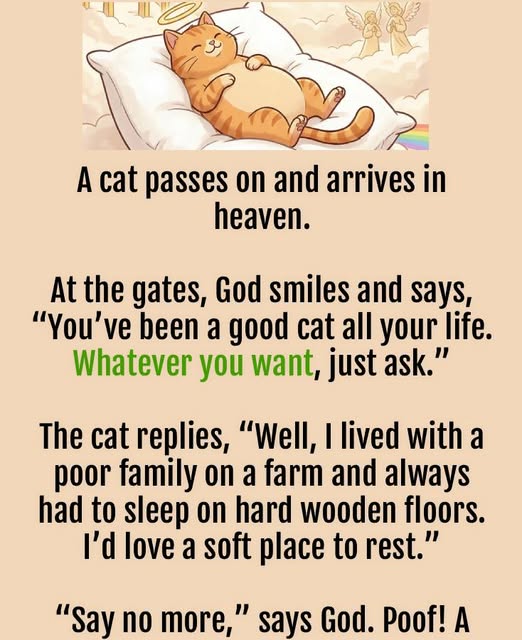
The punchline doesn’t arrive politely. It crashes in like a lightning bolt from a clear blue sky. First, you’re lulled into innocence: a dead farm cat strolling into heaven, exhausted from a lifetime of chasing shadows and sleeping in haylofts. He asks God, very simply, for what he never had on Earth—a soft pillow. Nothing extravagant. Just comfort. Meanwhile, a group of mice, still trembling from generations of terror, approach with their own desperate wish: roller skates, so they can finally outrun the claws that haunted their every waking moment.
God, benevolent and cheerful, grants both requests without hesitation. Paradise hums along. The cat purrs atop his cloud-soft pillow. The mice strap on their skates and zoom joyfully through heaven’s streets, laughing in relief at their newfound freedom. It’s all sweetness and divine generosity—until the camera pulls back and the punchline lands with surgical precision: God proudly announces He’s started “Meals on Wheels.” And suddenly, heaven isn’t just a sanctuary. It’s a cartoon crime scene. The mice’s miracle has become a conveyor belt of terror, the cat’s comfort paired perfectly with a never-ending buffet. Divine kindness meets cosmic oversight, and the result is dark, flawless comedy.
Then the scene shifts back to Earth, where irony trades halos for hard hats and coffee mugs. Four men stand shoulder to shoulder, each boasting about how brilliant their cat is. One demonstrates geometry—his cat expertly calculating angles and shapes. Another shows off accounting skills, with neat columns and perfect sums. The third dazzles with chemistry, bubbling beakers and controlled reactions. Each performance is impressive, logical, clean. A celebration of intelligence.
Then comes the government worker.
He doesn’t brag. He barely gestures. His cat doesn’t calculate or analyze. Instead, it eats the paperwork. Knocks over the setup. Creates confusion. Files complaints. Causes delays. And then—right on schedule—disappears entirely, only to be explained away as “on paid leave.” No brilliance. No precision. Just chaos, consumption, and absence. And somehow, it’s the most accurate demonstration of all.
Together, these two jokes mirror each other in a way that lingers. Whether it’s heaven or bureaucracy, pillows or paperwork, good intentions don’t always lead to good outcomes. Sometimes the system works perfectly—just not for the people (or mice) who thought they were being helped. And that’s the real punchline: the beneficiaries are rarely the ones who asked.