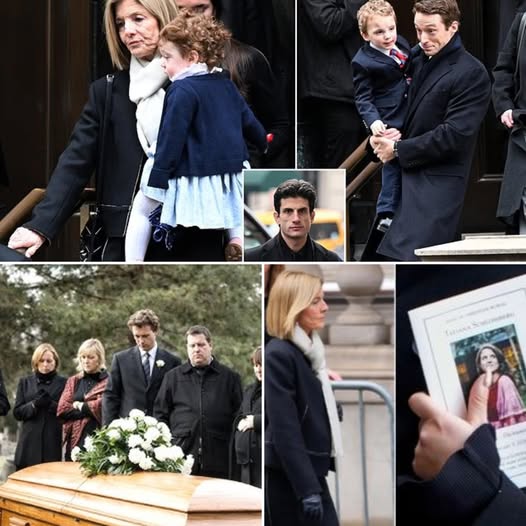
Caroline Kennedy held her granddaughter close as the church fell into a reverent hush. The silence wasn’t empty—it was heavy, weighted with the unspoken terror every family dreads: how do you explain death to children who still mispronounce their own names? A young mother was gone. Another chapter of America’s most storied political family had ended in grief. Inside a Manhattan church long entwined with Kennedy sorrow, mourners wrestled with the same impossible question that echoed through the pews: how do you bury not just a daughter, but the future she was meant to live?
On a cold January morning in New York City, three generations of Kennedys crossed the threshold of St. Ignatius of Loyola knowing that life, from this point forward, would be irrevocably divided into before and after. Caroline Kennedy entered quietly, cradling baby Josephine, her face composed but etched with a grief too deep to disguise. Ahead of her walked her son Jack and her son-in-law, Dr. George Moran, who gently guided little Edwin, small fingers wrapped tightly around his own. This was the same church that once held the memorial for Jacqueline Kennedy Onassis—another sacred space now asked to absorb unbearable loss. Family members, lifelong friends, and President Joe Biden gathered not to make speeches, but to stand witness to a family once again forced to mourn in public.
Yet even in that crushing sorrow, there was a resolute refusal to let Tatiana Schlossberg be remembered only for how she died. Those who spoke of her painted a vivid portrait of a woman defined by purpose and fierce compassion—a gifted environmental journalist whose words carried urgency, clarity, and moral weight. Tatiana wrote about climate, justice, and responsibility not as abstractions, but as promises owed to the next generation, including her own children. She understood what was at stake, and she wrote as if time mattered—because for her, it did.
In her final months, Tatiana turned inward as much as she turned outward. She filled notebooks with letters, preserved small moments, and clung to the rituals of ordinary love: bedtime routines, laughter at the kitchen table, the quiet intimacy of being present. Those who left the church that morning carried more than grief with them. They carried a shared vow—that Edwin and Josephine would grow up knowing their mother not only as someone they lost too soon, but as someone who lived with courage, conviction, and joy. Tatiana Schlossberg’s life, they insisted, would not end at the altar of tragedy. It would continue—in memory, in action, and in the children who would one day understand just how fiercely their mother loved the world she was trying to protect.