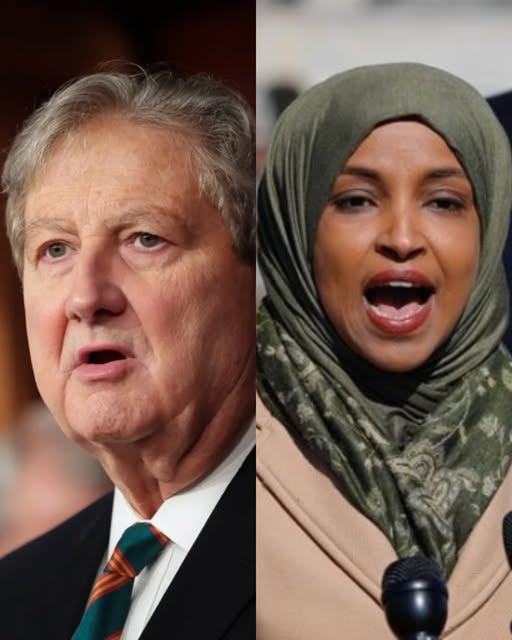
Every camera in the room snapped toward him at once, lenses locking in like a firing squad waiting for a single command. The chamber—moments earlier roaring with rehearsed outrage and overlapping sound bites—collapsed into a silence so precise it felt engineered, sharp enough to slice through marble and ego alike. Omar’s words stalled mid-sentence, unfinished, suspended in the air like a thought suddenly deemed unsafe. Across the aisle, AOC’s confidence flickered—not gone, not broken, but briefly unmoored, just long enough to betray that something unexpected had entered the room. Then Kennedy inhaled. And in that measured breath, the balance shifted. The narrative wobbled. The moral geometry of the moment tilted, as though history itself had leaned forward and murmured, listen closely.
He didn’t shout. That was the first disruption. In a chamber addicted to volume, outrage, and the promise of viral immortality, Kennedy’s restraint sounded almost defiant. His voice carried no theatrical edge, no hunger for applause. Instead, it carried weight. He spoke of duty as something solemn, almost sacred—not a costume to be worn for cameras, but a burden to be carried in silence. He spoke of power as borrowed, not possessed, something that could be revoked the moment it was abused. With every sentence, the marble walls seemed to close in, the cameras forgotten, the restless staffers stilled, as if the room itself were being asked to remember why it existed.
Omar’s hand drifted down from the microphone, the gesture slow, unconscious, like someone realizing too late that the ground beneath them has changed. Ocasio-Cortez straightened, her expression tightening—not in open defiance, but in calculation, the look of a strategist forced to reassess the terrain. Kennedy wasn’t aiming at them alone. He wasn’t sparring, posturing, or scoring points. He was issuing an indictment of an entire political culture that had traded stewardship for spectacle, governance for performance, responsibility for reach.
And for a fleeting, fragile moment, the machinery of modern politics stalled. No one was campaigning. No one was chasing a headline. No one was thinking about what would clip well online. They were, all of them, reduced to what they were supposed to be from the start: temporary custodians of a public trust larger than ambition, larger than ego, larger than their own names. In the stillness he left behind, one question lingered, heavy and unavoidable—had they honored that trust, or merely worn it like a badge?