They stared in open disbelief as the words left his mouth: the United States, Donald Trump declared, should own Greenland.
What began as another high-profile appearance quickly spiraled into something far more volatile. Within minutes, Trump had managed to insult longtime allies, rattle European markets, and resurrect his most unsettling habit—casually hinting at the use of “excessive strength and force” as if it were just another bargaining chip. Stocks dipped almost immediately. Diplomats exchanged furious calls. NATO’s already-strained unity suddenly felt like thin ice cracking under pressure. And when Trump capped it off by mocking windmill buyers as “stupid people,” even some of his most loyal defenders seemed to recoil, unsure whether to laugh, cringe, or quietly look away.
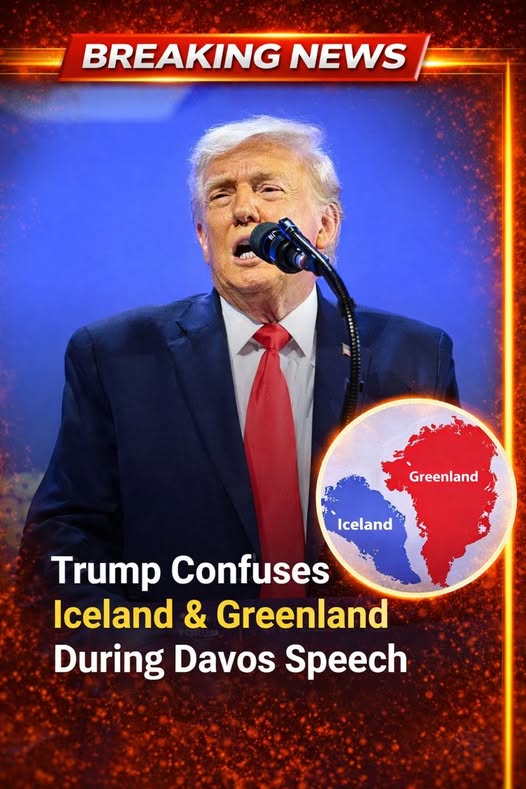
Trump’s long-anticipated appearance at the World Economic Forum in Davos was supposed to be a statement of leadership. Instead, it unfolded like a geopolitical showdown—less policy address, more provocation. He arrived late, fresh off an emergency U-turn by Air Force One that only heightened the drama, and launched into a blistering critique of Europe’s “seriously weakened” leaders. He questioned whether NATO could still be trusted, scoffed at collective security, and then veered into a baffling aside that appeared to blame a dip in the U.S. stock market on Iceland. The room, packed with heads of state, CEOs, and diplomats, shifted uneasily as the speech veered from confrontational to surreal.
Then came Greenland—the moment that froze the room. Trump framed control of the Arctic island not as an ambition but as an “obligation,” insisting that only the United States could properly defend it in an increasingly unstable world. He spoke of building a vast “golden dome,” a symbol of American dominance and protection, and dismissed Denmark’s sovereignty concerns as secondary to Washington’s strategic needs. It was imperial rhetoric dressed up as security policy, delivered with the confidence of a man who sees borders as negotiable and alliances as transactional.
Europe did not stay silent. French President Emmanuel Macron responded sharply, casting the moment as a stark moral choice between “respect” and “bullies.” Belgium’s prime minister reached for biting satire, comparing Trump to The Very Hungry Caterpillar—a figure that consumes everything in its path, leaving devastation where trust once stood. Behind the jokes and speeches, anxiety ran deep. Trump openly floated tariff threats—first 10 percent, then 25 percent—dangling them over European economies like a blade, explicitly linking economic punishment to Denmark’s refusal to sell land that is not for sale.
In a matter of minutes, Davos was transformed. What is usually a carefully choreographed forum for cooperation, climate pledges, and global stability became a live stress test of the international order—and of Trump himself. How far, leaders wondered, is he willing to go to get what he wants? How much pressure can alliances withstand before they fracture? And what happens when the language of deals and dominance replaces the language of diplomacy?
By the time Trump left the stage, the applause was polite, the smiles strained, and the message unmistakable. Davos had not witnessed a routine speech. It had watched a warning—one that echoed far beyond the snowy Swiss mountains, into markets, ministries, and capitals now bracing for what might come next.