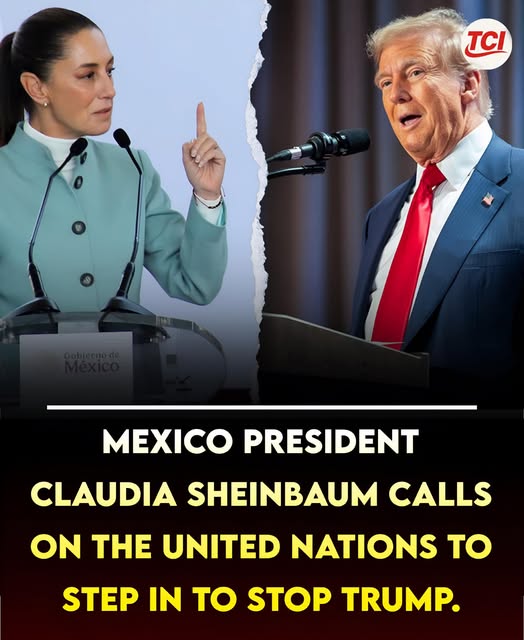
Mexico’s warning landed across the hemisphere like a crack of thunder — sharp, unapologetic, and unmistakably serious. In an unusually forceful public rebuke, President Claudia Sheinbaum directly challenged the United States over what Mexico described as an unauthorized military operation in Venezuela that ended in the capture of President Nicolás Maduro, a move that sent shockwaves through international capitals and ignited fierce debate about sovereignty, law, and power in the Americas.
Sheinbaum’s statement was more than a simple criticism; it was a strategic declaration of principle — a red line drawn in the sands of diplomatic norms. Mexico invoked the United Nations Charter’s prohibition on the use of force, underscoring Article 2(4)’s injunction against threats or actions that violate territorial integrity or political independence — principles Mexico says the U.S. action flagrantly disregarded. In echoing its longstanding Estrada Doctrine of non‑intervention, Mexico tied its own historical identity to the defense of international law, reminding the world that Latin America’s memory of foreign troops on its soil is still raw and resonant.
Across capitals from Brasília to Bogotá, leaders quietly acknowledged the gravity of the moment. Brazil’s president voiced alarm at the precedent such unilateral action sets, warning it could destabilize regional cooperation, while others expressed deep concern about the potential normalization of extraterritorial force as a policy tool. Sheinbaum’s framing struck a chord precisely because it transcended ideological divides: whether left, right, or center, many governments fear that the rules of engagement in the Western Hemisphere may be shifting without their consent.
At the heart of Mexico’s message was a plea for multilateralism, a call to return to negotiation and collective deliberation rather than resorting to bombs and special operations. Sheinbaum pressed for the United Nations — not Washington alone — to take a leading role in de‑escalating tensions and guiding a path forward grounded in diplomacy rather than force.
But her statement also carried a subtle message directly for Washington: cooperation on critical issues such as migration, cross‑border security, and trade cannot — and should not — be held hostage to silence on matters of law and sovereignty. Mexico is eager to partner with the United States on confronting cartels and tackling the flow of fentanyl and weapons, yet firmly insists that such cooperation must respect Mexican autonomy and constitutional principle.
In choosing law over loyalty and prudence over pressure, Mexico signaled that the real struggle extends beyond Caracas and into the broader question of how power will be exercised and constrained in the Americas. Will diplomacy and shared legal norms prevail, or are we entering a new era where might overtakes right and the hemisphere’s foundational rules are rewritten? The point now hangs at the center of regional debate — charged with uncertainty, but impossible to ignore.