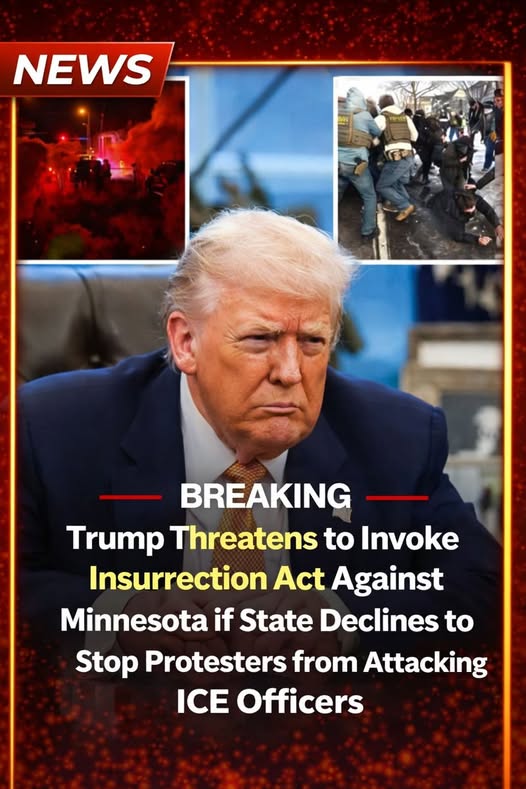
The warning landed like a political bombshell, detonating long‑buried tensions across Minnesota and far beyond. In the quiet hours of a winter morning, President Donald Trump unleashed a late‑night social‑media salvo threatening to invoke the Insurrection Act, a nearly two‑century‑old federal law that would allow the deployment of U.S. military forces onto American streets — an extraordinary step not seen in decades.
What began as a routine enforcement operation has mushroomed into a full‑blown national crisis. Minneapolis — a city already reeling after the fatal shooting of 37‑year‑old Renee Good by an ICE agent during heightened immigration operations — now finds itself at the epicenter of escalating protests, fierce clashes, and furious political debate.
For local residents, the threat of U.S. troops patrolling downtown boulevards and neighborhood blocks is not an abstract hypothetical; it is a chilling possibility that could redefine the relationship between citizens and their federal government. In recent days, protests that began with anger over aggressive federal immigration raids have swelled into scenes of tear gas, flash‑bangs, and arrests — incidents that Trump and his allies now claim constitute “insurrection” against federal authority.
To Trump’s supporters, the looming invocation of the Insurrection Act is a necessary show of force — a way to protect federal officers and assert control in jurisdictions the White House dismisses as “lawless” and defiant. Many Republicans argue that Minnesota officials have failed to rein in what they see as violent agitation, and that stronger federal action is justified to safeguard enforcement personnel and uphold the rule of law.
But to critics, this is not about law and order — it is about overreach, political posturing, and a dangerous expansion of presidential power. Governors, mayors, civil liberties groups, and legal scholars warn that using a military authority designed for wars and rebellions to police domestic protests — especially ones sparked by the death of a U.S. citizen during a contentious ICE operation — crosses constitutional lines and undermines the balance between federal and state authority. Minnesota officials have already filed lawsuits seeking to halt the federal surge, framing the crisis as a historic clash over states’ rights, policing, and the limits of executive power.
Behind the headlines, behind the legal briefs and fractious political rhetoric, are real people living in fear and uncertainty. Neighborhoods once defined by ordinary rhythms — school runs, coffee with neighbors, community gatherings — now brace for each new day with anxiety. Immigrant families wonder whether the next knock on their door will come with a warrant, a weapon, or worse. Local police, stretched thin by overlapping responsibilities, struggle to maintain order and trust amid rising tensions. This is not simply a dispute over policy — it is a community in crisis and a nation watching closely as a profound test of American democracy unfolds.