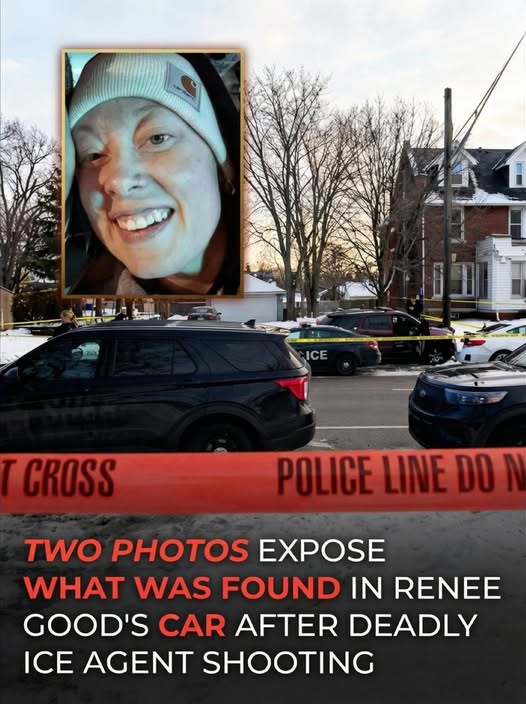
The morning began like any other.
The sun rose over the quiet streets, casting a soft golden hue on front porches and driveways slick with dew. Parents hurried children into cars, coffee cups steamed on dashboards, and the rhythm of another ordinary day began to hum through the neighborhood. No one could have imagined that by noon, one of their own—a mother of three—would be gone.
By afternoon, disbelief had turned the neighborhood into a tableau of stillness. The familiar hum of daily life—barking dogs, car doors slamming, laughter from the corner house—was replaced by an uneasy quiet. Renee Marshall, a woman known for her kindness, her poetry, and her habit of checking on others before herself, had become the center of a tragedy that seemed both impossible and incomprehensible.
Witnesses recall a flurry of sirens, flashing lights, and confusion that descended without warning. There was talk of federal officers, a school drop-off that turned tense, a sudden crash, and a woman caught in the middle of something she never should have been part of. What happened in those final moments remains tangled in conflicting accounts and official statements that shed little light. Facts are debated. Explanations shift. But the grief—raw, silent, and unyielding—is shared by all.
Now, Renee’s street stands as both memorial and mystery. The swing set in her backyard sits still, its chains creaking in the wind like a quiet lament. Her children’s chalk drawings on the driveway—flowers, hearts, the word “Mom”—have faded under the weight of rain and time. Where there was once the rhythm of life—morning school runs, quick waves from passing cars, shared laughter on sidewalks—there is now an ache that settles deep and refuses to leave.
Friends and neighbors gather in soft-spoken clusters, their voices barely above whispers. They trade stories not of her final day, but of the countless days before it. They speak of her open door and open heart—the woman who stayed late to help clean up after school events, who brought soup to the sick, who found beauty in the simplest things and captured it in poems she never sought to publish. To them, Renee was not just kind; she was a steady light, one that never asked for recognition but made the world brighter by existing in it.
As national commentators debate tactics, accountability, and blame, those who knew her hold onto something far more fragile and sacred—the truth of who she was. They resist her reduction to a headline or symbol. In their hearts, Renee remains what she always was: a mother, a friend, a quiet force of empathy who wove care into the fabric of her community without ever demanding attention.
Her absence has changed everything.
It lingers in the spaces she once filled so effortlessly—in the morning routines, the laughter after dinner, the unspoken comfort of knowing she was just a phone call away. Where routine once reigned, there is now a silence heavy with memory and love unspent.
Renee’s story may have ended suddenly, but her influence endures in the lives she touched—a testament not to how she died, but to how fully she lived.