The room didn’t just go quiet. It cracked.
It was the kind of silence that doesn’t descend—it detonates. One command. Three brutal syllables. And suddenly, every buried fault line in American politics split open at once. The air turned electric. Staffers froze mid-breath. Cameras zoomed in, capturing the stillness before the inevitable storm. Reporters gripped their pens tighter, already writing the headlines in their minds.
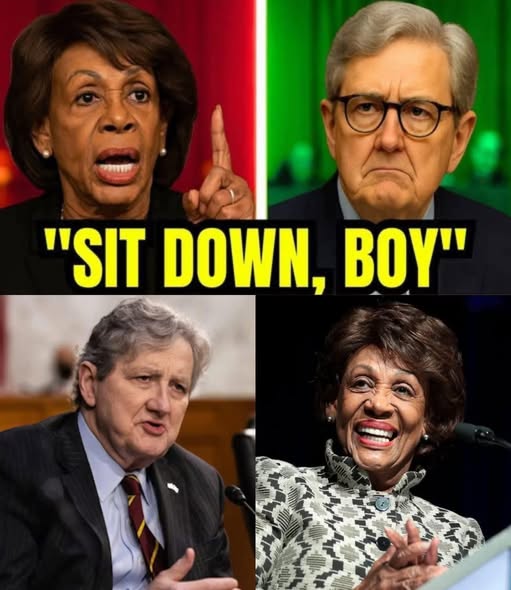
At the center of it all sat Senator John Kennedy, motionless but alert, the weight of a thousand unseen eyes pressing down on him. He didn’t flinch. Didn’t blink. Just a small movement—his hand reaching up to remove his glasses, the gesture slow, deliberate, almost surgical. The light caught on the rim as he looked up, not at the ceiling, not at the cameras, but straight at his accuser.
He could have met fire with fire. The room expected it—the raised voice, the sharp retort, the televised confrontation that would dominate the news cycle for days. Everyone waited for the explosion. But it never came.
Instead, Kennedy did something no one in that chamber was prepared for. He paused. He let the insult hang there in the thick air, refusing to dignify it with outrage or scorn. The silence stretched—uncomfortable, almost unbearable—and in that silence, he chose his ground.
When he finally spoke, his words were calm, even kind. Measured, not meek. Controlled, but undeniably human. He neither lashed out nor yielded; instead, he redefined the moment on his own terms. His restraint wasn’t weakness—it was strategy. A quiet defiance. A refusal to let someone else dictate the story.
And in that choice, the dynamic shifted. The power flipped.
What had begun as a public humiliation became something else entirely—a test of character, not rhetoric. Kennedy had turned what could have been a viral shouting match into a study in composure, leaving both his supporters and critics momentarily disarmed.
Representative Waters’ words didn’t just echo through that chamber—they ricocheted across the country. Within hours, they were dissected on cable panels, replayed on social media, and debated in family living rooms. For some, her outburst was righteous anger—a raw, unfiltered expression of frustration in a system too long tilted toward privilege. For others, it was unforgivable disrespect, proof of everything they believed was broken in political discourse.
But as the noise swelled, what lingered wasn’t the insult itself—it was the response.
In a culture addicted to spectacle, where fury is currency and humiliation is entertainment, Kennedy’s refusal to play the part became its own quiet rebellion. He didn’t win by outshouting; he won by outlasting. By keeping his dignity when the room demanded drama.
That moment became more than a headline—it became a mirror. It forced the country to ask itself what kind of politics it wanted: the theater of fury or the discipline of grace. And as the clip played on loop, people found themselves not just choosing sides—but questioning which kind of strength they truly admired.
Because sometimes the loudest statement isn’t made with a raised voice.
Sometimes, it’s made in the silence that follows.