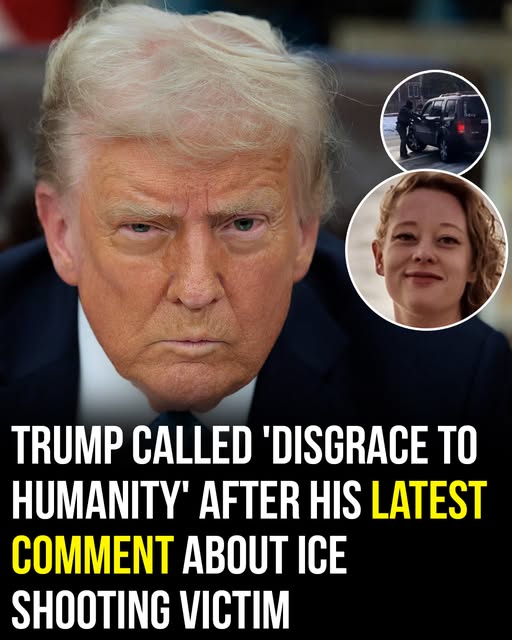
The video is unbearable. A terrified woman. A flash of panic. A gunshot. And then — silence.
In less than ten seconds, a life ends and a nation begins to fracture all over again.
In Minneapolis, 37-year-old Renee Nicole Good lies dead — an ICE bullet through her skull, her car crumpled against a parked SUV. What remains of her final moments now loops endlessly on every screen in America, dissected frame by frame by strangers who never knew her name until it was too late. To some, she is a martyr. To others, a menace. To her family, she was simply Renee — a gentle soul who cared for neighbors, volunteered at shelters, and hated confrontation.
But the story of her death has already been claimed, twisted, and weaponized.
The video, filmed by a bystander trembling behind a windshield, shows Renee sitting in her car, cornered in an icy parking lot. ICE agents swarm around her vehicle. A voice shouts orders. The car inches forward — then a hand grabs the door handle. She screams. Another agent raises his gun. The shot rings out, echoing across the frozen street. Her head jerks. The car rolls forward until it collides with a parked sedan. Then nothing — just the awful quiet that always follows violence.
Within hours, Minneapolis erupted. Mayor Jacob Frey, visibly shaken, called the killing “an act of lawless brutality” and demanded ICE leave his city. “You are not protecting us,” he said. “You are killing us.” Protesters filled the streets within hours, their chants — Say her name. Renee Good. — rising into the night. The city once again found itself at the intersection of grief and fury, haunted by memories of George Floyd and the same impossible question: how many times can a city watch a person die on camera before it breaks completely?
But in Washington, the reaction could not have been more different.
Within minutes of the video surfacing, President Donald Trump took to Truth Social to rewrite the narrative. “A PROFESSIONAL AGITATOR,” he wrote, accusing Renee of ramming officers with her car and calling the shooting “100% justified.” Vice President JD Vance echoed the message, praising the ICE officer’s “courage under attack” and vowing to “stand with law enforcement against domestic extremists.” Homeland Security followed suit, labeling the incident “domestic terrorism” — a phrase that only deepened the wound.
To her mother, those words felt like another death. “They called my baby a terrorist,” she told reporters through tears. “She was running because she was scared. That’s all. She was scared.”
Online, the country split apart instantly — two realities coexisting, each accusing the other of blindness. In one, Renee Good is a victim of a system built on fear and control. In the other, she’s a threat who brought tragedy on herself. On social media, the arguments blurred into rage. Hashtags trended. Comment sections became battlegrounds. Every replay of the video felt like another blow — not just to her family, but to whatever fragile trust Americans still had in one another.
Alexandria Ocasio-Cortez called the shooting “public murder.” Civil rights attorneys demanded indictments. Conservative pundits hailed the ICE officer as a hero. And through it all, Renee’s family planned a funeral they could barely afford — one that would take place under police watch, just in case the grief spilled over again.
What’s left now is a nation arguing not just over blame, but over truth itself.
Renee Nicole Good is gone — her life reduced to ten seconds of terror, forever frozen on a stranger’s phone. What remains is the argument she never asked to start: when the state kills in the name of safety, who gets to define what safety means?
Once again, America is staring into a mirror — and what it sees depends entirely on which side of the line you stand on.