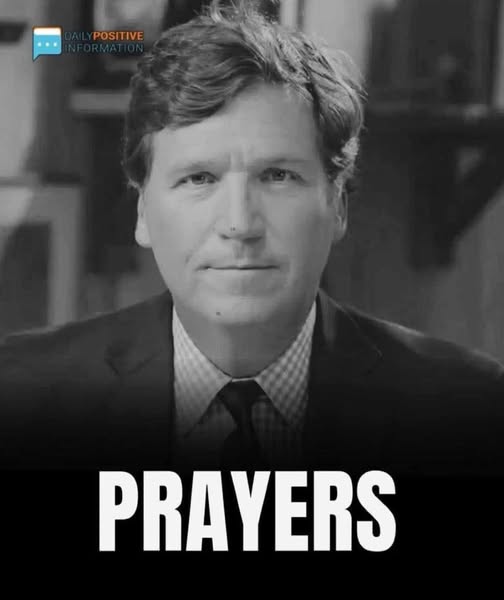
The toughest man Tucker Carlson ever knew has died — but the story behind that toughness isn’t what you think. It wasn’t born on a battlefield or in the backrooms of Washington, but in the silence of a Boston orphanage, where an abandoned baby boy learned that survival begins with self-reliance. Richard “Dick” Warner Carlson spent a lifetime building himself from nothing: a child no one claimed, a teenage Marine, a journalist chasing truth, a diplomat shaping it, and finally, a father who refused to let his sons feel the loneliness he once knew too well.
He entered the world unwanted — the son of a frightened, fifteen-year-old girl who spoke only Swedish. She left him in a crib at an orphanage with a note and no name. He cycled through foster homes and state care before finally being adopted, a journey that taught him early how fragile love could be, and how fiercely it had to be protected once found.
By seventeen, he had been expelled from high school and enlisted in the Marine Corps — a decision that, in hindsight, looked less like rebellion than salvation. The Marines gave him structure, identity, and the first true sense of belonging. From there, he clawed his way upward, propelled by grit and intellect. He became a journalist — the kind who wrote not from ideology but curiosity, chasing stories from Saigon to Sarajevo, convinced that truth, however inconvenient, was worth the risk.
In the years that followed, Richard Carlson’s name became synonymous with integrity and edge. He anchored newscasts, broke political scandals, and eventually moved into government service, becoming U.S. ambassador to the Seychelles and later head of Voice of America. Yet for all his proximity to power, he never seemed seduced by it. Friends remember him as a man more interested in history books than cocktail parties — a sharp wit with a soft spot for strays, both human and canine.
But the role that defined him most was not diplomat or journalist — it was father. After his first marriage ended, he raised his two boys, Tucker and Buckley, largely on his own. Their dinner table was less a place for small talk than for argument, laughter, and lessons on how to think, not what to think. “He made everything into a seminar,” Tucker once recalled — revolutions, literature, philosophy, the constancy of human nature. And beneath the intellect was something simpler: devotion. He showed up. He stayed.
When Richard remarried, it was to Patricia Swanson — heiress to the Swanson frozen-food fortune and, by all accounts, the love of his life. Their marriage lasted four decades, a union of quiet loyalty and shared humor. Her death left him hollowed but never bitter. Those who visited him in his final years saw a man marked by loss but sustained by faith — the kind of faith that believes pain has purpose, and that clarity is better than comfort.
So when the end came, Richard Carlson refused painkillers. He wanted to stay present — to feel the last chapters of his story as fully as he had lived the rest. His dogs lay beside him, his children at his side, his faith unshaken.
He died the way he lived: steady, stoic, unflinching. The orphaned boy who had once been left behind left this world surrounded by love.
In the end, that was his quiet triumph — not the titles, not the travels, but the transformation. A life that began with abandonment ended with belonging, and a legacy that still lives on in the minds he shaped, the family he built, and the stories he left behind.