Minneapolis woke to horror and disbelief.
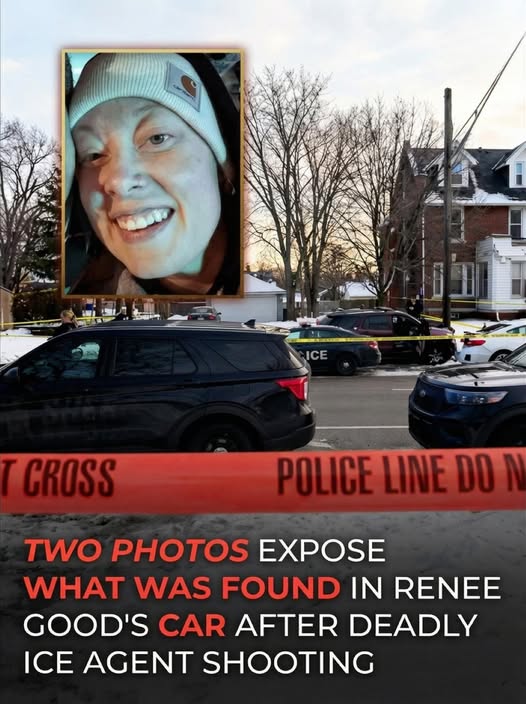
Renee Nicole Good — a poet, a mother, a neighbor whose laughter once filled snowy sidewalks — lay lifeless beside her shattered SUV. Hours earlier, she had been baking cookies for her children’s school fundraiser. Now, the same hands that wrote verses about kindness and healing were covered in blood and glass, her body marked by bullets fired by a federal ICE agent.
Officials called it self-defense.
Witnesses called it murder.
The confrontation, caught on a trembling cell phone camera, spread across the nation before sunrise — a woman’s final moments, framed by flashing lights and freezing breath. Her wife’s screams tore through the Minneapolis night, echoing between apartment buildings and church walls. It was not just grief that filled her voice, but something more complicated — guilt, fury, disbelief that this country could turn a citizen’s quiet life into a national spectacle overnight.
In the days since the killing, Minneapolis has become a city on edge — a battleground between two conflicting realities.
Federal officials insist that the ICE officer opened fire to “save lives,” portraying Renee as a potential domestic terror threat who had “weaponized her vehicle.” Yet the video tells another story: agents walking away without a scratch, a motionless body inside a bullet-riddled car, and the echoing shouts of neighbors demanding to know why.
City leaders have openly defied Washington’s version of events. The mayor called the shooting “an execution under the banner of law.” Community activists accuse federal agencies of “governing by reality TV,” chasing headlines instead of justice. The tension is raw — part tragedy, part reckoning, part reminder of how quickly truth becomes a casualty in the nation’s culture wars.
But beyond the noise, beyond the talking points and hashtags, lies the quiet devastation of a family.
Renee wasn’t a threat. She was a musician who played piano at church on Sundays, a poet who wrote about love and forgiveness, a woman whose kitchen always smelled like cinnamon and honey. Her mother described her as “gentle to a fault — someone who forgave too easily.” Her six-year-old son keeps asking when she’s coming home, not yet understanding that she never will.
Neighbors have turned their grief into nightly vigils. Candles line the frozen sidewalks where she once walked her dog. Strangers leave handwritten notes tucked under bouquets: “You deserved better.” “We remember you.” “Justice for Renee.”
Minneapolis is a city in mourning — and in defiance.
A community determined that Renee Nicole Good will not fade into another contested headline or cold case of political convenience. Her death, captured in brutal clarity, has become a mirror held up to a divided nation. And in that reflection, one truth is impossible to deny: a poet who believed in grace died on a winter street, and the country she loved is still arguing over why.