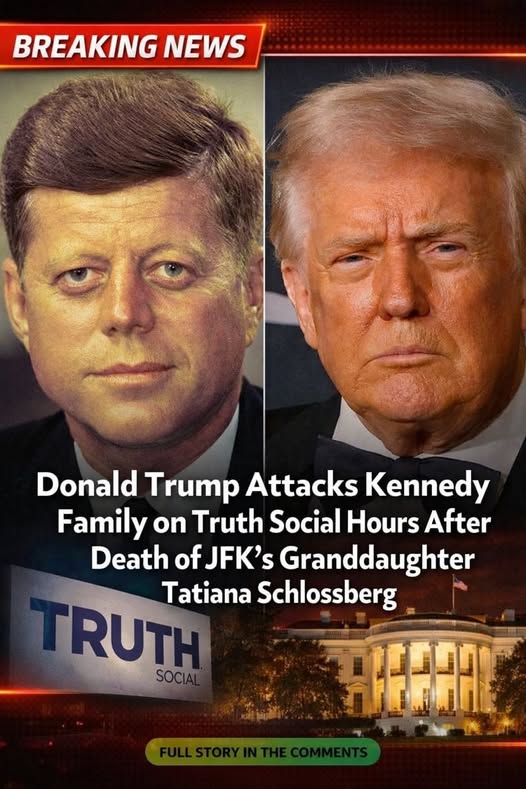
It began with heartbreak — and ended in cruelty.
As Tatiana Schlossberg, the 35-year-old daughter of Caroline Kennedy and granddaughter of President John F. Kennedy, lost her devastating battle with leukemia, America’s most storied political family was thrust into a kind of sorrow that no lineage, no legacy, could shield them from. Yet even as the Kennedys gathered in quiet prayer, the internet turned merciless. And from the highest corners of political power came something colder still — mockery.
Inside the family’s circle, grief ran deep. Tatiana’s husband, George Moran, was left to comfort their two young children while generations of Kennedys, from Hyannis Port to New York, clung to one another in disbelief. Friends spoke of her strength, her humor, and her fierce devotion to family — a young woman who had inherited the Kennedy grace but built a life defined by purpose, not privilege. Maria Shriver called her “a bright light extinguished too soon,” while others recalled her warmth, her love of writing, and her refusal to let illness define her.
Outside that private mourning, however, the noise grew louder. In a stunning twist, the Kennedy Center — a monument to her grandfather’s legacy — was suddenly at the center of political fire. A controversial rebranding effort had erupted: a move to rename it the “Trump-Kennedy Center.” Allegations of a rigged vote, silenced board members, and backroom pressure sent shockwaves through Washington’s arts and political circles.
Then came the posts — Donald Trump amplifying cruel jabs and sarcastic memes aimed at the grieving family. What should have been a moment of national reflection became another cultural battlefield, where reverence gave way to ridicule.
The contrast could not have been sharper. Inside the Kennedy homes, candles burned, prayers were whispered, and the next generation tried to make sense of loss. Outside, the family name — once synonymous with idealism, courage, and sacrifice — was being twisted into a talking point, a pawn in someone else’s war for attention.
It was, in every sense, a portrait of modern America: a family in mourning, a country divided, and a legacy caught between reverence and rage. Tatiana Schlossberg’s death was a human tragedy — and yet, somehow, it became a political spectacle.
Through it all, those who loved her most tried to drown out the noise, remembering her not as a headline, but as a daughter, a mother, and a woman who carried the Kennedy light with quiet strength — until the very end.