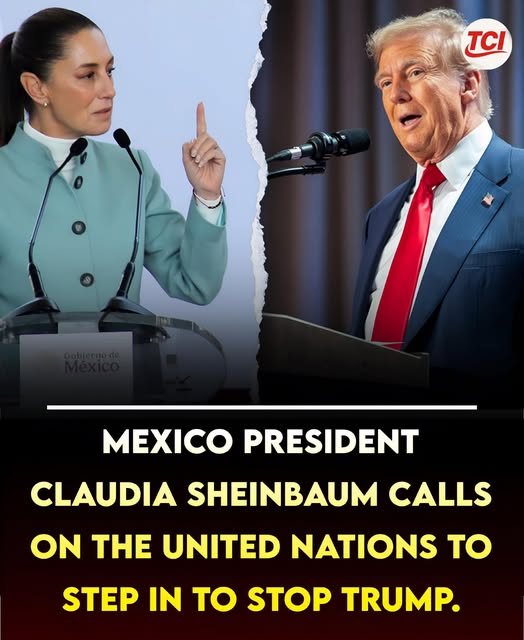
Mexico’s warning reverberated across the Americas like a seismic shock. In one of the most forceful public rebukes in recent memory, Mexican President Claudia Sheinbaum tore into the United States, accusing Washington of shredding the very fabric of international law with its surprise military operation in Venezuela — an action that culminated in the capture of Venezuelan President Nicolás Maduro by U.S. forces, an event that has sparked controversy and alarm throughout the region. Her words were not a casual critique; they were a clarion call rooted in deep historical memory and legal principle, warning that the age-old specter of foreign boots on sovereign soil — once all too familiar in Latin America — may be rising again. Reuters+1
Sheinbaum’s statement did more than condemn a single strike; it redefined Mexico’s posture on the global stage. Drawing explicitly on the United Nations Charter and Mexico’s own constitutional commitment to non-intervention, she framed the reported U.S. action not as a tactical disagreement but as a fundamental breach of sovereignty with ramifications far beyond Caracas. In her view, such unilateral military intervention threatens the stability of every nation in the hemisphere, regardless of political persuasion — a refrain that struck a chord across Latin America, where memories of Cold War-era coups, covert operations, and externally imposed governments remain painfully vivid. Anadolu Ajansı+1
Sheinbaum placed multilateralism at the heart of her response, urging that disputes among states be resolved through dialogue, diplomacy, and adherence to international norms rather than by force of arms. By invoking the UN Charter’s prohibition on the use of force and Mexico’s long-standing Estrada Doctrine — the principle that nations should respect the sovereignty and self-determination of others — she signaled that law, not power, must govern international relations. That insistence resonated not only with Mexico’s allies but also with global leaders who see the recent U.S. action as a dangerous precedent. Anadolu Ajansı
In challenging Washington’s conduct, Sheinbaum also sent a clear message about the limits of cooperation: while Mexico remains engaged with the United States on shared concerns such as migration, security, trade, and transnational crime, those strategic partnerships cannot come at the expense of core principles like sovereignty and legal order. She made it clear that cooperation should not require silence in the face of what she described as violations of international law — that respect for diplomacy must coexist with practical collaboration. apnews.com
This moment — already generating loud debate across capitals from Brasília to Bogotá — isn’t just about Venezuela. It is shaping up as a broader contest over the rules that will govern power in the Americas, testing whether states can uphold collective legal norms in the face of strategic might. At stake isn’t only the fate of one government, but the very architecture of regional diplomacy. TIME