The capital shook before the first light of dawn.
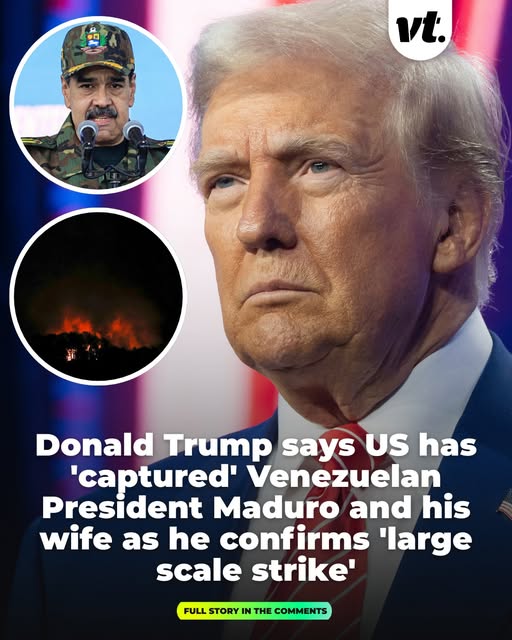
Sirens screamed across the streets of Caracas. Explosions lit the sky like deadly fireworks, scattering sparks over rooftops and sending clouds of smoke drifting toward the Andes. Traffic ground to a halt. Families huddled in hallways. And somewhere in the chaos, Nicolás Maduro — Venezuela’s unflinching, embattled president — vanished into the haze, along with his wife, Cilia Flores.
By the time the news reached global airwaves, Donald Trump was on camera, his voice brimming with triumph. From Mar-a-Lago, he hailed what he called a “brilliant operation,” praising the precision of U.S. Delta Force commandos and declaring that the United States had seized Maduro and Flores in a dramatic strike against “narco-terrorism and tyranny.” Behind him, aides smiled, charts of oil production flashed across screens, and the announcement was framed as an unequivocal victory for American power and justice.
In Caracas, the scene was almost apocalyptic. Furious generals denounced the operation as barbarism, a desecration of Venezuelan sovereignty, and a threat to the entire region. In government offices and on state television, Maduro’s allies called the U.S. strike an imperialist plot, warning citizens to mobilize against what they framed as a calculated grab for Venezuela’s oil, mineral wealth, and strategic influence.
Overhead, low-flying aircraft cast long shadows on the streets. Explosions rattled neighborhoods in Caracas, Miranda, La Guaira, and Aragua, leaving Venezuelans scrambling for information, scouring the sky, and scrolling through social media feeds for fragments of truth. Rumors swirled faster than the smoke: some said Maduro had been captured and whisked away; others feared the president had been killed in the chaos.
Inside the military hierarchy, tension ran high. Defense Minister Vladimir Padrino López vowed the creation of an “indestructible wall of resistance,” promising that loyalist forces would defend the nation’s borders and cities. Yet even as he spoke, officials privately admitted that the whereabouts of Maduro and Flores were unknown, leaving a fragile command structure vulnerable to panic, dissent, and opportunism.
Vice President Delcy Rodríguez, speaking with rare urgency on state television, demanded immediate proof of life for the president and his wife. Her words were both plea and warning: the country could not accept uncertainty, and foreign aggression would not go unanswered. Meanwhile, across the border in Bogotá, Colombian President Gustavo Petro issued a sharp warning. Missiles over Caracas, he said, could escalate into regional war. He called for the United Nations to intervene immediately, urging global powers to prevent Venezuela’s crisis from spiraling into a wider conflict engulfing the hemisphere.
In the streets, a tense silence alternated with the distant roar of aircraft. Citizens peered from windows, children clutched their parents, and neighborhoods became islands of unease. The capital, usually alive with early morning chatter and the honk of traffic, was frozen — waiting, watching, uncertain of what would come next.
In a single night, Venezuela’s government had gone from confident and defiant to unmoored and desperate. A president had disappeared, military command was rattled, and the region — already fragile — now teetered on the edge of chaos. For the people of Caracas, the question was simple yet terrifying: who really controlled the skies, the streets, and the fate of their country?