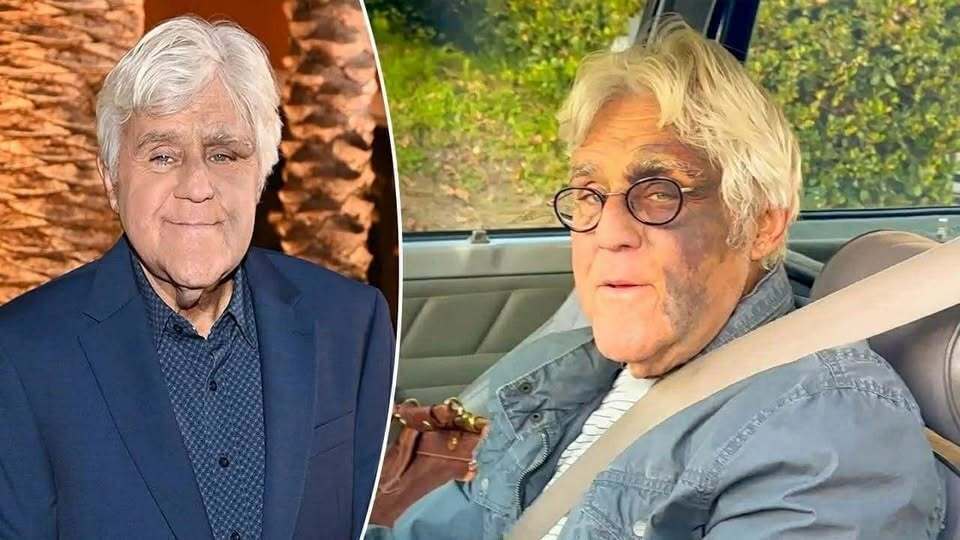
Jay Leno’s Final Drive: The Man, the Fire, and the Legacy That Will Outlive Him
He has walked through fire—twice.
Not metaphorically, but literally. Twice pulled from the wreckage of flame and steel, his skin burned, his body scarred, his humor somehow untouched. The man who made America laugh until it cried now spends his quiet hours behind a desk, signing documents that contain no punchlines—only permanence. There are no roaring crowds, no cue cards, no spotlights. Just a pen, a will, and a legacy about to shift gears for the final time.
Somewhere in Burbank, hidden behind nondescript walls and the faint scent of oil, a museum waits for its master’s final signature. Inside are hundreds of engines—sleek, loud, defiant pieces of history that once purred and thundered under Jay Leno’s watchful eye. They are not trophies; they are memories made of metal. Each one tells a story of a man who has always measured time not in years, but in miles.
The Road That Made the Man
For Jay Leno, life has never been about stillness. His story unfolds like a cross-country drive, beginning in New Rochelle, New York, where a working-class kid with a crooked grin and a knack for punchlines dreamed of the open road. He built his life one laugh at a time, one audience at a time, until his name became synonymous with The Tonight Show, comedy’s most coveted stage.
Yet for all the glitter of Hollywood, Leno’s heart was always in his garage. Long after the applause faded, you could find him there—hands black with grease, a wrench glinting under fluorescent light, an old carburetor humming back to life. While others collected mansions, he collected stories told through engines. Where others sought comfort, he sought combustion.
The road, for him, was not escape. It was reflection. Every mile clocked behind the wheel of a restored Duesenberg or McLaren was another conversation with time—one that asked, What truly endures?
Fire and Forged Steel
When the fire came—first from a gasoline explosion, then again from a brutal motorcycle crash—it seemed like the universe was reminding him that even steel bends. The burns, the grafts, the surgeries—all of it could have dimmed him. But instead, it refined him.
Leno emerged with the same unshakable optimism that made him a national fixture. He returned to his garage, sleeves rolled up, face still marked by recovery, ready to turn another bolt. The pain was part of the process. “You fix what’s broken,” he once said, “and you keep going.”
That philosophy applied to both engines and existence.
A Legacy Written in Ink and Chrome
Now, at 75, Jay Leno’s latest act isn’t a comeback special or farewell tour—it’s a gesture of gratitude. He is quietly arranging to leave the bulk of his estate to the preservation of his collection, ensuring that the machines that defined his life will continue to inspire long after he’s gone. The vehicles—ranging from century-old steam cars to futuristic prototypes—will become part of a public museum, a monument not to fame, but to passion.
No headlines, no fanfare—just an act of devotion to the craft and culture that shaped him. The laughter will fade. The late-night clips will yellow with age. But those engines, those gleaming pieces of history, will remain. They will hum softly in the stillness, carrying his story like a low, eternal rumble beneath the California sky.
The Man Behind the Wheel
For all his fortune and fame, Jay Leno has always been most comfortable in solitude—between the roar of pistons and the hum of thought. Fame, for him, was fuel, not destination. What mattered most was motion: the act of building, fixing, driving.
In the end, it’s fitting that his legacy is not a monument of marble or a line of statues, but a symphony of engines. They are alive, breathing remnants of his curiosity and discipline. They are, in their way, his laughter made mechanical.
The Forever Road
So when his heart—and his engines—finally go silent, the world will still hear him. In every polished curve of chrome, in every engine that roars to life decades from now, there will be a whisper of the man who loved machines more than applause, work more than rest, and motion more than fame.
Jay Leno has found his version of forever.
Not in the echoes of laughter—but in the purr of engines that will never stop telling his story.