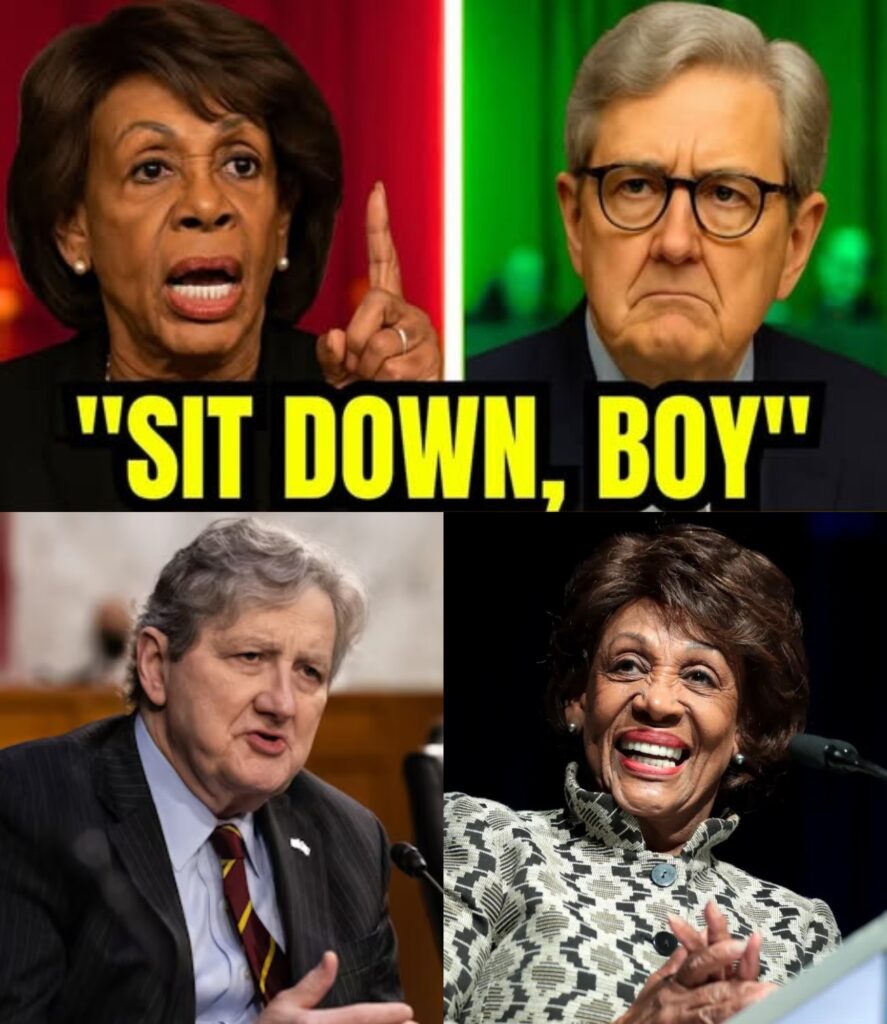
The room seemed to stop breathing. One phrase—three clipped words—landed like a match tossed onto decades of unspoken tension. When Maxine Waters said, “Sit down, boy,” the atmosphere shifted instantly. Conversations died mid-thought. Cameras zoomed in with predatory precision. Staffers stiffened, frozen between disbelief and anticipation. In that moment, the hearing ceased to be routine and became something volatile, something historic.
Across the room, John Kennedy did not react the way many expected. There was no outburst, no flash of anger, no reflexive attempt to reclaim dominance. Instead, he reached up slowly and removed his glasses, a small, deliberate gesture that carried more weight than any raised voice. Silence followed—not an absence of sound, but a charged, suffocating quiet. It was the kind of silence that demands attention, the kind that signals a decision has been made.
In that suspended moment after Waters’ command, Kennedy’s restraint became its own form of speech. He didn’t rush to defend himself. He didn’t trade insult for insult or perform outrage for the cameras. Each second stretched, daring the room to misread his calm as weakness. When he finally lifted his eyes to meet hers, the audience was braced for confrontation, for the verbal detonation everyone assumed was inevitable.
But it never came.
Instead, Kennedy delivered a single, measured sentence—steady, composed, and unmistakably intentional. It did not plead, and it did not provoke. It rejected humiliation without surrendering to spectacle. In doing so, he made clear that he would not be transformed into a character in someone else’s viral clip, nor dragged into a performance designed to inflame rather than inform.
That choice altered the meaning of the entire exchange. What began as a sharp insult became something far larger: a mirror held up to the fault lines of American politics itself. Power, race, respect, and history all collided in that brief encounter. To some viewers, Waters’ words echoed as righteous defiance; to others, they rang as an unacceptable provocation. Kennedy’s restraint was praised by supporters as dignity under fire, while critics dismissed it as calculated silence.
Yet beyond the partisan interpretations and endless replays, something deeper was exposed. The moment revealed just how fragile decorum has become, and how quickly a forum meant for policy and governance can devolve into a symbolic battleground over identity and authority. In the end, it wasn’t shouting that unsettled the nation. It wasn’t theatrics or fury.
It was the quiet—and what that quiet said about where American politics now stands.