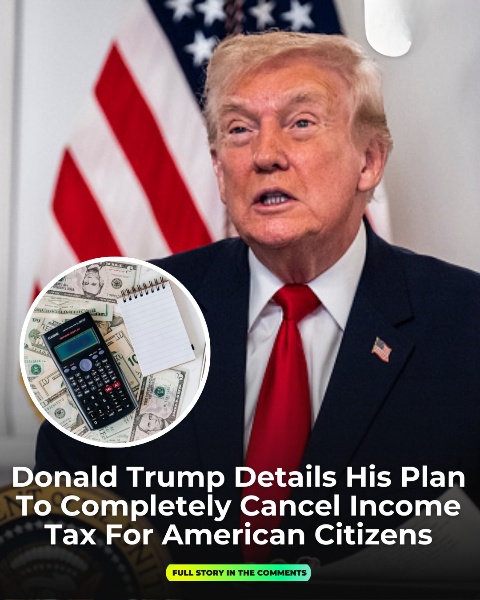
Donald Trump’s bold pledge to eliminate the federal income tax — replacing it entirely with revenue from tariffs on foreign goods — has struck a powerful emotional chord across the nation. It’s more than just a policy proposal; it’s a rallying cry. For millions of Americans, weary of complicated tax codes and yearly battles with the IRS, the idea of never filing another return feels like poetic justice — a symbolic strike against a bureaucracy they believe has long taken more than its fair share.
Trump has cast the plan in sweeping, patriotic terms, framing it as nothing less than a financial revolution. In his words, the United States should “stop taxing our citizens” and instead make foreign producers pay the cost of America’s prosperity. It’s a promise designed to sound simple, even righteous: shift the burden from working families to imported goods, let tariffs power the federal government, and restore what he calls “economic fairness for the American worker.”
The emotional resonance of that message cannot be overstated. For decades, taxpayers have felt trapped in a system they see as both punitive and opaque — one that rewards loopholes and punishes ordinary effort. Trump’s vision channels that frustration into a single, electrifying idea: freedom from the taxman. The appeal is visceral — the notion that the global marketplace, not the American household, should carry the weight of government spending.
Yet behind the fiery rhetoric lies an unyielding mathematical reality. Federal income taxes currently supply more than half of the nation’s total revenue, funding everything from national defense to Social Security to infrastructure. Tariffs, by comparison, bring in only a small fraction of that amount. To bridge such an enormous gap solely through duties on imports would require either astronomical tariff rates — so high they could cripple trade — or a massive surge in imports that runs counter to the very logic of protectionism.
Economists warn that the arithmetic simply doesn’t add up. Higher tariffs tend to reduce, not increase, imports. They also raise prices for consumers and businesses alike, often triggering retaliatory measures from trading partners. What begins as a patriotic vision of self-reliance can quickly spiral into a global trade war — one where the cost of everyday goods climbs, supply chains strain, and the very workers the policy aims to protect end up paying more at the checkout counter.
Still, Trump’s proposal captures something deeper than fiscal policy — a yearning for control, simplicity, and fairness in a world that feels increasingly tilted against the middle class. It’s a slogan of defiance, wrapped in the language of liberation: No more tax returns. No more IRS. America first — paid for by the rest of the world.
For now, though, that vision remains more poetry than policy — an electrifying promise colliding head-on with the cold, immovable reality of the federal ledger.