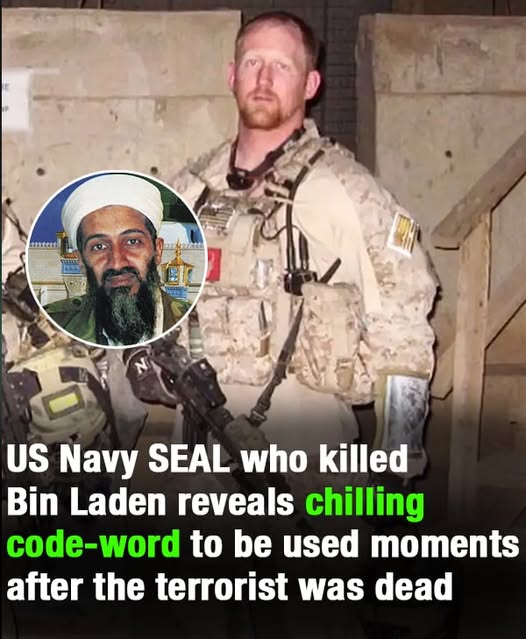
The man widely credited with firing the final shots that killed Osama bin Laden has often said that the most powerful words he ever heard were never intended for the public ear. They were not shouted. They were not dramatic in the moment. Instead, they arrived through the crackle of a radio, in the middle of chaos, as a calm, almost clinical code that marked the end of one of the most significant manhunts in modern history.
It began with a night that would later be dissected by the world in documentaries, books, and intelligence reports—but for those inside it, there was only motion, noise, and seconds that refused to slow down. A helicopter cutting through the darkness toward Abbottabad. A sudden, violent crash that turned precision into survival. Then, a rapid transition from confusion to discipline as the assault team pushed forward into an unknown compound, clearing rooms under pressure, with visibility limited and every doorway potentially decisive.
In that tightening sequence of moments, former Navy SEAL Robert O’Neill would later describe a choice that defined everything that followed: instead of waiting for reinforcement or certainty, the team advanced. Step by step, floor by floor, they moved deeper into the compound until they reached the third level—where the mission narrowed into a single corridor, a single doorway, and a single breath before contact.
Behind that doorway, history waited in an ordinary-looking bedroom. A figure stood partially obscured, shielded by another person in a desperate attempt to delay the inevitable. In that confined space, there was no room for hesitation. O’Neill fired, and in that instant, a global pursuit that had spanned nearly a decade reached its final, irreversible conclusion.
But the moment that echoed far beyond that room did not happen there. It came through the radio, from operators coordinating the mission in real time, relaying confirmation to command centers thousands of miles away. The code name was “Geronimo.” The transmission was steady, almost detached, as though trying to contain the weight of what it signified:
“Geronimo… Geronimo… Geronimo… Geronimo EKIA.”
Enemy Killed In Action.
In Washington, inside the Situation Room, the atmosphere was tense in a different way—compressed, silent, waiting for certainty that could not be assumed until it was spoken aloud. When the confirmation finally came through, President Barack Obama reportedly turned to those present and delivered a short, restrained acknowledgment that released years of intelligence work and global uncertainty in a single breath: “We got him.”
For the operators on the ground, however, there was no celebration in that instant—only movement, procedure, and the continuation of the mission until extraction. The world outside would react later, in waves of disbelief, relief, and controversy.
Years afterward, O’Neill broke from the unspoken code of silence that surrounds SEAL operations, stepping into public scrutiny to confirm his role in the raid. His decision was met with both recognition and criticism, but he has maintained that the weight of the story had become heavier than the secrecy meant to protect it.
Fifteen years on, he still describes that night not as a single heroic moment, but as a chain of irreversible decisions—each one compressed into seconds, each one leading to a doorway that changed history.