Donald Trump set social media ablaze over the weekend after unleashing a rapid-fire series of posts that left supporters, critics, and casual observers equally stunned.
Late Saturday night, in what quickly became one of the most surreal online episodes of his political career, Trump posted a whirlwind of content over the course of about an hour. The stream ranged from bizarre AI-generated fantasy scenes to sharp political jabs, patriotic imagery, and meme-style declarations—creating a chaotic digital narrative that was difficult for even longtime followers to track in real time.
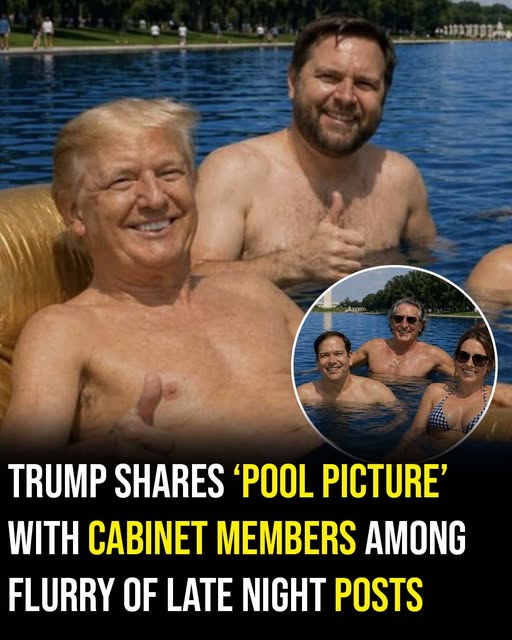
The spree began shortly after 11 p.m. with a striking and widely shared AI-generated image featuring Trump alongside JD Vance and Marco Rubio. In the image, the trio stood shirtless in the Reflecting Pool at the Lincoln Memorial—an unusual and theatrical visual that immediately drew attention online.
The post appeared to tie into an ongoing redesign project involving the historic site. According to Trump’s commentary, the Reflecting Pool is being resurfaced and transformed into a bold “American flag blue,” rather than restored to its traditional granite appearance. He followed up with additional posts praising the redesign while criticizing how the area looked during the presidency of Barack Obama, contrasting past aesthetics with his vision for a more striking, symbolic look.
But the tone of the posts quickly shifted.
In a more puzzling moment, Trump shared a photograph of First Lady Melania Trump smiling shortly after an alleged assassination attempt connected to the White House Correspondents’ Dinner. The image appeared without any caption or explanation, leaving viewers confused and prompting speculation about its meaning.
Minutes later, Trump pivoted again—this time returning to familiar political territory. In a sharply worded post, he targeted Hakeem Jeffries, calling him “Low IQ” and labeling him a “thug.” The remarks quickly triggered backlash across social media, with critics condemning the rhetoric as inflammatory and inappropriate.
The intensity didn’t stop there.
Trump soon shared a digitally altered image depicting his face carved into Mount Rushmore alongside George Washington, Thomas Jefferson, Theodore Roosevelt, and Abraham Lincoln. While many dismissed it as a meme, the concept has surfaced before—Trump has previously suggested the idea publicly, calling it “a good idea,” though no serious proposal has ever advanced.
Still, it was the final post of the night that arguably captured the spirit of the entire spree.
In a bold, almost cinematic image, Trump was shown gripping a handful of UNO wild cards, accompanied by the caption: “I have all the cards.” The message, cryptic yet assertive, fueled speculation about its political meaning while reinforcing the theatrical tone of the evening.
This unusual burst of activity came just days after another controversy involving AI-generated imagery. Earlier in the week, Trump had shared a picture that many interpreted as portraying him as a Christ-like figure performing a miracle. When questioned about the reaction, he dismissed the criticism outright, insisting the image was misunderstood.
Taken together, the late-night posting spree painted a vivid picture of Trump’s online persona—unpredictable, provocative, and deeply attuned to spectacle. Whether intended as political messaging, digital performance art, or something in between, the posts once again demonstrated his unmatched ability to dominate attention in the modern media landscape.