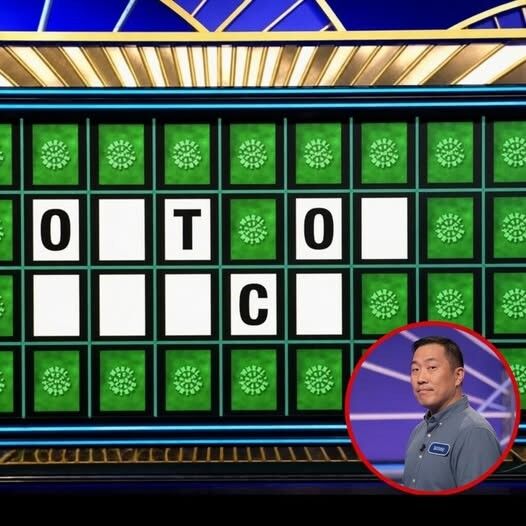
The studio lights shimmered brightly, the audience buzzing with anticipation, and for a moment everything felt like just another playful afternoon of television. Laughter bounced across the set, coworkers exchanged teasing remarks, and what was billed as a friendly “Bragging Rights” office edition of Wheel of Fortune seemed destined to be nothing more than good-natured fun.
But that illusion didn’t last long.
Almost without warning, the atmosphere began to shift—subtle at first, then unmistakably heavy. What started as a lighthearted workplace showdown quickly transformed into something far more intense: a high-pressure test of composure, timing, and nerve. Host Ryan Seacrest kept the energy light on the surface, joking with contestants and leaning into office familiarity, but even his humor couldn’t fully mask the growing tension beneath each spin of the wheel.
The contestants weren’t just playing for cash—they were playing for pride, reputation, and the thrill of outperforming their coworkers on national television. Every spin carried weight. Every correct answer built momentum. And every hesitation felt longer than it should have.
Early on, Sam Oh emerged as a confident force, solving puzzles with ease and quickly climbing the leaderboard. His steady rhythm and calm demeanor gave him an early advantage, while Peter Jung held his ground with consistent, strategic play. Jung even found himself in the spotlight when Seacrest playfully referenced his past connection to fellow contestant Daniel Park—who, in a twist of workplace coincidence, had once been Jung’s pediatric patient. The revelation sparked laughter across the stage, momentarily lightening the competitive air and turning the game into something resembling a reunion of intertwined lives.
Meanwhile, Park began slowly, almost cautiously, watching the others gain ground. But he didn’t fade. Instead, he recalibrated. With each turn, he pushed back against the slow start, refusing to let the moment slip away from him. His persistence quietly reshaped the balance of the game, tightening the race and raising the stakes for everyone involved.
By the time the final rounds approached, the playful energy had evolved into something sharper. Every correct guess was met with applause—but also with the growing awareness that one decision, one hesitation, could change everything.
Then came the Bonus Round.
The studio seemed to contract around Sam Oh as he stepped into the spotlight alone. The noise softened, the laughter faded, and the familiar glow of the stage lights suddenly felt more like a spotlight under interrogation. The category was “Phrase,” deceptively simple, yet notoriously unforgiving in moments like this.
Letters appeared. Patterns formed. The answer hovered just out of reach.
You could almost see the mental calculations happening in real time—familiar words dancing at the edge of certainty, just close enough to tempt confidence but just incomplete enough to sow doubt. The pressure thickened with every passing second.
Then came the guess.
“Out of…”
A pause.
And then the reveal.
“Out of Whack.”
Wrong.
Just like that, a single moment of hesitation and uncertainty erased a potential $40,000 prize—and a shot at the elusive $1 million bonus. The kind of swing that feels impossible in hindsight, yet completely real in the moment it happens.
The reaction was immediate and electric. Social media lit up within minutes, flooded with reactions ranging from sympathetic disbelief to stunned commentary about how cruelly close the solution had been. It was one of those moments where viewers collectively feel the weight of “what could have been.”
And yet, behind the scenes, the tone softened. The tension dissolved into laughter, conversation, and perspective. Despite the missed opportunity, Sam Oh still walked away as the episode’s overall winner, his performance strong enough to carry him through the game.
But the story lingered beyond the final spin.
Because what unfolded wasn’t just a game show outcome—it was a reminder of how fragile momentum can be under pressure. How knowledge alone isn’t always enough. And how, in the decisive seconds when everything narrows down to a single answer, it’s not just what you know that matters—but how you hold yourself when the entire room is watching.