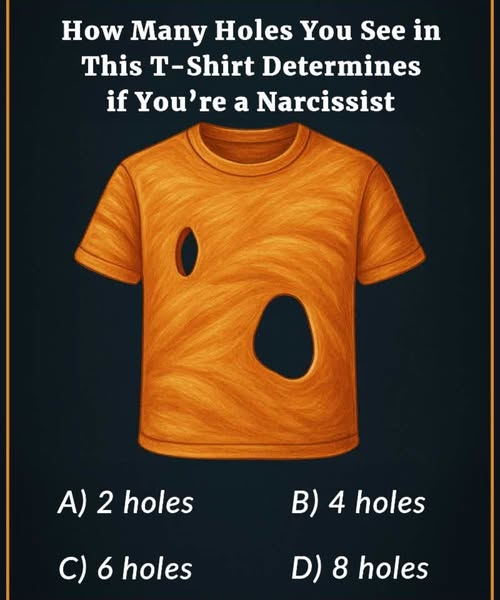
An ordinary image: a worn, orange T-shirt, slightly crumpled, visibly torn. Nothing remarkable at first glance. Then comes a deceptively simple question: “How many holes do you see?”
And just like that, the calm shatters. What should be a quick answer turns into a surprisingly intense debate. Thousands—then millions—of people begin to argue, defend their answers, rethink their assumptions. A trivial riddle transforms into something much deeper: a quiet, almost invisible test of perception, attention, and the subtle shortcuts our brains take without permission.
At the heart of this puzzle is not the shirt itself, but the way it exposes the mechanics of human thinking. Some people glance quickly and lock onto the two obvious tears in the fabric. To them, the answer feels immediate, almost undeniable. Why complicate something so clear?
But others hesitate. They look again—more slowly this time. Their attention shifts. They begin to question what actually counts as a “hole.” Suddenly, the definition expands. The neckline? A hole. The sleeves? Two more. The bottom opening? Another. What once seemed like a simple visual count turns into a conceptual puzzle, where interpretation matters just as much as observation.
That small shift—redefining what qualifies as a hole—changes everything. The answer grows, the certainty fades, and the conversation deepens. What once felt obvious becomes debatable. What once seemed trivial becomes layered.
If you count every intentional opening in the shirt, along with the visible tears, the most consistent answer lands at six. Yet arriving at that number isn’t really the point. The real significance lies in the journey—how quickly we assume, how rarely we pause, and how differently two people can interpret the exact same image.
This humble orange T-shirt becomes something more than a puzzle. It becomes a mirror. It reflects the tension between instinct and analysis, between speed and accuracy. It shows how the mind prefers efficiency, often filling in gaps without checking the details.
And perhaps most importantly, it offers a quiet reminder: even the simplest questions deserve a second look. Because sometimes, what we miss at first glance says more about how we think than the answer itself.