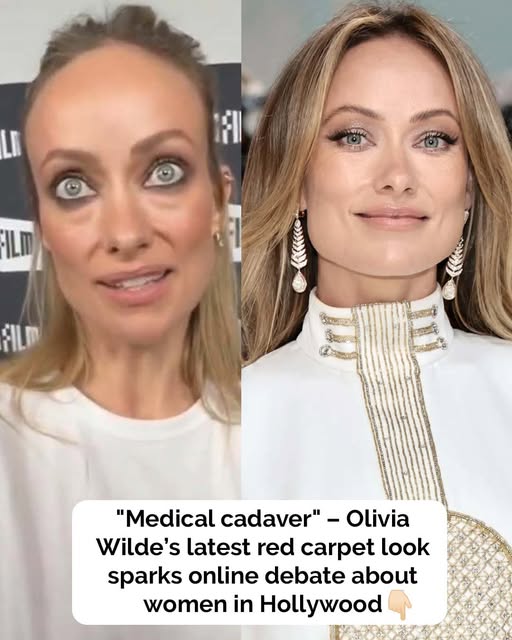
Olivia Wilde recently sat down for what was meant to be a routine promotional interview discussing her upcoming film The Invite. It should have been a light, industry-focused conversation about storytelling, comedy, and the creative process behind the project. Instead, within hours, the internet redirected the spotlight away from her work—and toward her body.
A short clip from the interview began circulating rapidly across social media, and almost immediately the tone shifted. What might have once been a passing moment of celebrity coverage transformed into a wave of intense scrutiny, speculation, and commentary about Wilde’s appearance. Rather than discussing her film, thousands of online users began debating her face, frame, and perceived changes, turning a simple press appearance into a viral flashpoint.
The discourse escalated quickly. Some users questioned whether she was ill, others speculated about weight-loss medications, while many attributed the look to aging, lighting, or camera distortion. Amid the swirl of conflicting opinions, a single inflammatory post describing her appearance in dehumanizing terms ignited an even larger chain reaction—fueling mockery from some corners of the internet and performative concern from others. What followed was a familiar pattern: a public figure’s image dissected in fragments, stripped of context, and reconstructed through speculation.
Yet much of the disagreement online revealed less about Wilde herself and more about the lens through which audiences continue to view women in the public eye. Some defended her appearance as completely normal, pointing out the effects of angles, unedited footage, and the unrealistic expectations placed on women—especially those who have spent decades in Hollywood. Others doubled down on alarmist interpretations, as though any visible change must signal something hidden or wrong.
In contrast to the chaos surrounding the clip, Wilde’s own long-standing perspective on fame and visibility feels especially relevant. She has often spoken about the artificial nature of celebrity imagery—the way lighting, styling, editing, and selective framing construct versions of people that are consumed as reality. She has also criticized the way public figures, particularly women, are often treated as if their bodies are public property, open to judgment, correction, and endless commentary.
This latest episode underscores a persistent cultural tension: the difficulty many still have in accepting visible aging and natural variation in women’s appearances without assigning them meaning, diagnosis, or narrative. What should have remained a brief promotional moment instead became another example of how quickly attention can drift from a woman’s work to her body.
Meanwhile, the actual subject of the interview—her film The Invite, a comedy exploring relationships, neighbors, and underlying tensions—was largely overshadowed. In its place emerged a far more familiar story: one where a woman in Hollywood is once again positioned not as an artist discussing her craft, but as an image to be analyzed, debated, and endlessly interpreted.
In the end, the reaction says less about Olivia Wilde and far more about the culture watching her—a culture still learning, slowly and unevenly, how to separate visibility from permission, and appearance from meaning.