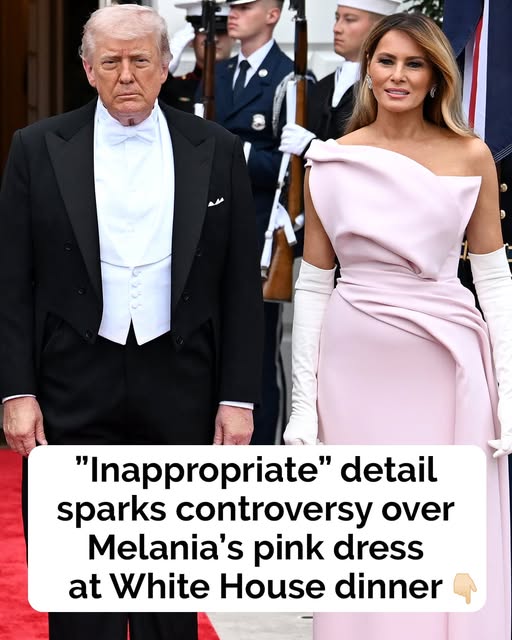
Melania Trump’s entrance at the White House state dinner didn’t just turn heads — it set off a wave of conversation that rippled far beyond the glittering room itself. In a setting defined by centuries of tradition, carefully choreographed etiquette, and quiet diplomatic symbolism, she arrived wearing something that would soon dominate headlines, social feeds, and dinner-table debates around the world.
It was a single choice of attire. A single moment under the chandeliers. Yet somehow, it became the centerpiece of a much larger cultural argument.
The gown in question — an $80,000 Dior creation — was a sculpted, strapless pink masterpiece that immediately distinguished her from the expected aesthetic of royal-formal dressing. Where such events typically lean toward restrained elegance, modest cuts, and subdued tones designed to complement rather than compete, her look did the opposite. It was bold, highly structured, and impossible to ignore.
Standing beside King Charles III and Queen Camilla, the contrast was even more striking. Critics quickly pointed to the exposed shoulders, the dramatic silhouette, and the towering heels as a departure from the quiet discipline traditionally associated with royal protocol. To them, it wasn’t just fashion — it was a statement that bordered on defiance, a visual disruption in a space where symbolism is everything and subtlety is often the unspoken rule.
But fashion, especially at this level, rarely speaks in a single voice.
Supporters saw something entirely different. To them, the look wasn’t a breach of etiquette but a masterclass in controlled presence. Melania Trump, long known for her carefully curated public image and precise sartorial choices, appeared fully aware of the attention she would command. Every detail — from the silhouette to the color to the confidence with which it was worn — suggested intention rather than accident. In their view, it was not disrespect, but assurance; not chaos, but command.
As images of the event circulated, the reaction split almost instantly. Social media became a battleground of interpretations. Some users framed the gown as inappropriate for the occasion, arguing that diplomacy demands deference to tradition. Others defended it as modern elegance, pointing out that high-profile state events have always included fashion moments that reflect individuality, influence, and evolving cultural norms. And then there were those who simply paused at the visuals themselves — the gown, the setting, the contrast — captivated by the spectacle regardless of the debate surrounding it.
Yet beyond the opinions, hashtags, and headlines, the dinner itself continued without interruption. Speeches were delivered, toasts were raised, and formalities were observed exactly as planned. Diplomacy, as always, moved forward.
But the image remained.
Long after the event concluded and the official photographs were archived, the discussion didn’t fade. Instead, it evolved into something more reflective — a broader question about visibility, tradition, and the quiet tension between them. In spaces where protocol has long dictated what is appropriate, what does it mean to stand out? And in a world that scrutinizes every public appearance, is it more controversial to challenge tradition — or to fade so seamlessly into it that you are no longer seen at all?