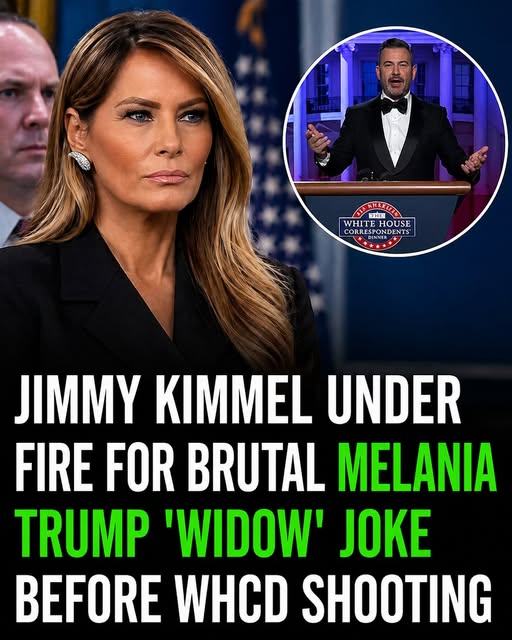
Late-night television has long been a space where humor and politics collide, but even within that tradition, certain moments can reignite intense public debate. Recently, one such moment has resurfaced, placing comedian and host Jimmy Kimmel back in the spotlight. A joke he delivered about former First Lady Melania Trump—originally part of a satirical segment tied to the White House Correspondents’ Dinner—has drawn renewed scrutiny, particularly in the wake of a recent security incident connected to the high-profile event.
The White House Correspondents’ Dinner, known for blending political commentary with entertainment, has historically provided comedians with a मंच to push boundaries. It celebrates journalism, honors press freedom, and raises funds for scholarships, all while allowing performers to inject humor into the often serious world of politics. Kimmel’s remarks were delivered within this very context—a setting where sharp wit, exaggeration, and pointed critiques are not only expected but often applauded.
At the time, the joke was one among many in a routine that took aim at political figures, including former President Donald Trump and his administration. Like much of late-night satire, it relied on irony and bold phrasing to provoke laughter and reflection. However, as clips of the segment began circulating again online—this time against the backdrop of heightened sensitivity following the recent incident—the tone and content of the joke have been reevaluated by audiences.
Critics argue that the remarks crossed a line, describing them as distasteful or poorly timed given current circumstances. For some, the resurfacing of the joke underscores a broader concern about how humor intersects with respect, especially when directed at public figures in a more personal context. On the other hand, defenders of Kimmel and the genre itself emphasize that satire has always played a crucial role in democratic discourse. They argue that comedy, by its nature, often exaggerates and provokes, serving as a mirror to political culture rather than a literal statement of intent.
The public response has been anything but uniform. Social media platforms and opinion columns have become arenas for debate, with voices on both sides expressing strong perspectives. Some call for greater sensitivity and restraint, while others caution against limiting creative expression in comedy. This divide highlights an ongoing cultural conversation: where should the line be drawn between humor and offense, and who ultimately gets to decide?
In the end, the resurfacing of this moment is less about a single joke and more about the evolving expectations placed on public figures, entertainers, and the media landscape as a whole. It reflects a society continually negotiating the balance between free expression and accountability—one punchline at a time.