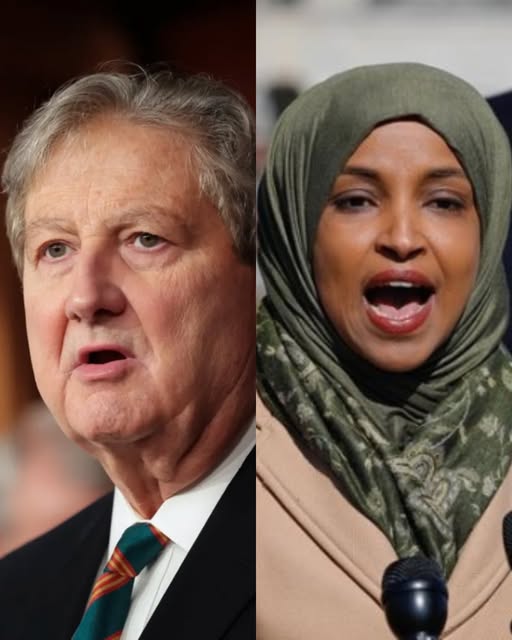
Every camera in the room seemed to lock onto him at once, as if the entire press corps had become a single mechanical eye. The sudden stillness felt deliberate, almost orchestrated—like a firing squad that had paused not out of mercy, but anticipation. The air itself changed texture. What had moments before been a chamber buzzing with rehearsed indignation, overlapping voices, and carefully timed outrage, collapsed into a silence so dense it felt almost physical, as if sound itself had been confiscated at the door.
Omar’s words, still hanging in the space he had just occupied, seemed to falter mid-flight and fall lifeless before they could land. Across the room, AOC’s confidence—so recently sharp, composed, and assured—wavered in the smallest but most revealing way. It wasn’t a collapse, not quite. It was something more subtle, more unsettling: a fractional hesitation, a flicker of recalculation, like a strategist suddenly realizing the map no longer matched the terrain.
Then Kennedy inhaled.
It was not a dramatic gesture. There was no theatrics, no performative pause designed for effect. And yet, in that single quiet breath, something in the room shifted. The balance—fragile as glass—tilted almost imperceptibly. The narrative that had been forming, the momentum that had been building, even the unspoken assumption of moral positioning, all of it seemed to bend as though history itself had leaned forward to listen more closely. For a fleeting instant, it felt as if time had slowed just enough to make space for consequence.
And then he spoke.
He did not raise his voice.
That, more than anything, was the shock.
In a place where volume often masqueraded as conviction and where certainty was usually measured in decibels and viral-ready soundbites, Kennedy’s calm landed like something unfamiliar—almost disruptive. His tone carried no urgency to dominate the room. Instead, it carried weight, as though every word had been carefully chosen not to win attention, but to deserve it.
He spoke of duty, not as a slogan or a political accessory, but as something almost sacred—something inherited, fragile, and easily betrayed. He spoke of power not as possession, but as temporary stewardship, a borrowed authority that could be lost the moment it was mistaken for ownership. With each sentence, the room seemed to contract slightly, as if the walls of marble and institutional grandeur were leaning inward to hear him more clearly. Even the cameras, those ever-present harvesters of spectacle, felt less like observers and more like witnesses caught in something unexpectedly solemn.
Staffers who had been shifting restlessly moments before now stood still, unsure whether to move, breathe, or simply listen. The usual choreography of politics—the glances, the interruptions, the subtle signals passed across the room—had dissolved into something quieter and more exposed.
Omar’s hand, which had been poised near the microphone with practiced readiness, slowly lowered. Not in surrender, but in something closer to uncertainty—a brief recalibration of position in a landscape that no longer behaved as expected.
AOC steadied herself. Her expression did not soften, nor did it break. Instead, it hardened into something more complex than defiance: calculation. It was the look of someone quietly redrawing boundaries in real time, reassessing arguments that had once felt stable, now rendered less certain by the unexpected gravity of what had just been said.
Because Kennedy was not directing fire at individuals. There was no personal edge, no partisan flourish designed to provoke reaction. Instead, his words seemed to bypass them entirely and strike at something larger, more abstract, and more uncomfortable—the culture itself. The culture that turns governance into performance. The culture that confuses visibility with virtue. The culture that rewards spectacle over substance until the two become indistinguishable.
And for a brief, fragile, almost impossible moment, the room stopped performing.
No one was campaigning.
No one was trending.
No one was calculating how the moment would look when clipped, shared, or replayed.
They were simply there—individuals inside a structure of immense public trust, suddenly and unavoidably reminded of what that trust was meant to mean. Not as rhetoric. Not as branding. But as responsibility.
And in the silence that followed, heavier than applause and more honest than outrage, Kennedy left a question hanging in the air—unspoken, unavoidable, and far more powerful than any argument:
Were they truly worthy of it?