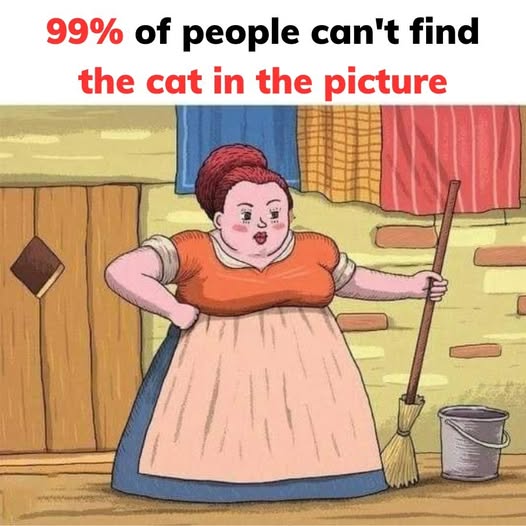
You feel stupid—and the feeling doesn’t just sit quietly; it presses in on you, tight and suffocating, like a room with no air. It scares you more than you want to admit. Not just because you might be wrong, but because of what being wrong seems to say about you.
The red circle doesn’t help. It isn’t neutral. It doesn’t gently guide your eyes. It accuses. It declares, “Look here. It’s obvious.” And yet, no matter how long you stare, no matter how intensely you focus, nothing clicks into place. Just shapes. Just noise. Just the growing, creeping suspicion that you’re missing something everyone else can see without effort.
And everyone else does seem to see it—or at least, that’s what they say. Their certainty feels loud, almost aggressive. You can practically hear it in their voices: “There it is.” “How can you not see it?” So you lean in closer, your eyes scanning every inch, your brain straining as if sheer willpower could force understanding into existence. Your heart starts to thud, not from the challenge itself, but from the pressure of what it means to fail.
The harder you look, the less you trust what you’re seeing. The image blurs, your thoughts tangle, and something deeper begins to unravel. Doubt doesn’t stay contained to the picture—it spreads. Quietly, insidiously. If you can’t trust your own eyes in something this simple, what else have you misunderstood? What else have you gotten wrong without even realizing it?
But it isn’t really about the cat.
It’s about that all-too-familiar moment—the one that leaves a faint, nauseating discomfort in your chest—when your perception collides with everyone else’s certainty. When the room seems aligned in one direction, and you’re the only one standing still, unsure. And instead of holding your ground, you adjust. You tell yourself they must be right. You let their confidence overwrite your doubt.
The red circle is just a symbol. A stand-in for all the times you’ve gone along to get along. All the times you’ve nodded, even when you didn’t understand. Laughed, even when you didn’t get the joke. Agreed something was “obvious,” even when it felt anything but. Not because you believed it—but because it was easier than being the one who didn’t.
Because being the outlier carries a cost.
And over time, those small moments add up. Each one feels insignificant on its own—a tiny compromise, a harmless adjustment. But together, they form a pattern. A quiet habit of sidelining your own perception in exchange for belonging. Safety. Acceptance.
That’s where the real discomfort comes from.
Not the image. Not the cat. But the realization of how easily, how consistently, you’ve learned to distrust yourself.
There’s a subtle kind of loss in that—a slow erosion of something essential. The belief that your way of seeing the world is valid. That your confusion doesn’t make you lesser. That your perspective, even when it differs, still deserves space.
And maybe the real shift—the meaningful one—doesn’t come from finally spotting what everyone else sees. Maybe it doesn’t come from proving you can “keep up” or forcing your mind into alignment with the crowd.
Maybe it comes in a quieter, braver moment.
The moment you pause, take a breath, and allow yourself to say—without apology, without embarrassment, without shrinking—
“I don’t see it.”
And then, even more importantly:
“I still trust myself.”