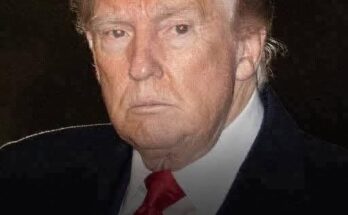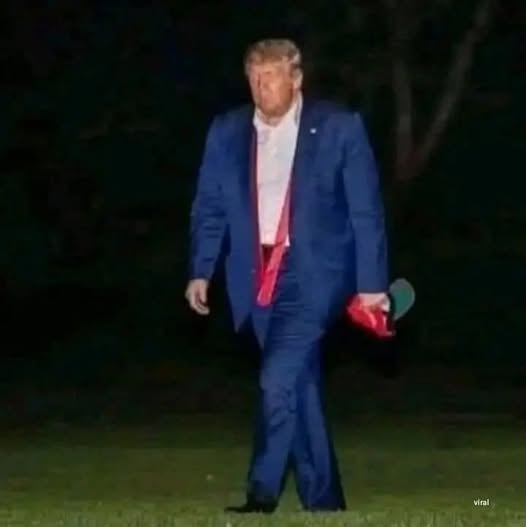
The silence of the night was suddenly broken by something unexpected—a solitary shadow moving beneath the faint glow of streetlights, a figure in a baseball cap slipping through the stillness as though it belonged more to the darkness than to the waking world.
Witnesses later claimed that Donald Trump was seen shortly after midnight, walking at an unhurried, deliberate pace. There was no entourage behind him, no flashing cameras, no security detail cutting through the quiet like a blade of authority. No motorcade rumbled in the distance. No podium waited beneath bright lights. Only a lone figure, a former president moving through the margins of an ordinary street, carrying something small in his hand—an object too indistinct, too uncertain, to be immediately identified. It caught the faint reflection of the streetlamps just enough to spark curiosity, glinting briefly before disappearing back into shadow.
Within hours, that single moment—fragile, unverified, and incomplete—began to ripple outward. Blurry photographs surfaced online, each one more pixelated than the last, each one fueling a growing storm of interpretation. Social media erupted almost instantly. Threads multiplied, theories collided, and speculation spread faster than any confirmed detail could possibly keep pace with. In the absence of clarity, imagination rushed in to fill the void, building narratives out of fragments, shadows, and suggestion.
But what lingered after the initial frenzy was not the object itself, nor even the question of what had been in his hand. Instead, it was something more revealing—something about the way perception bends under uncertainty. A quiet nighttime walk transformed into a national guessing game. A grainy image became a blank canvas onto which people projected their fears, their hopes, their suspicions, and their political beliefs. The story ceased to belong to the moment it came from; it became something shaped collectively, reshaped endlessly by those who consumed it.
In that space where facts had not yet arrived—or perhaps never would—people began to supply their own truths. Some saw symbolism where there may have been none. Others saw intention where there may have only been routine. And many simply saw confirmation of whatever they already believed, as though the blurry outline of a man in a cap could be molded into meaning by sheer force of interpretation.
This late-night sighting, whether ordinary or extraordinary, ultimately highlights how thin the boundary has become between curiosity and obsession in the modern age. Public figures exist under a constant magnification, where even the most private gestures risk being transformed into public material, dissected and distributed within minutes. Yet it also serves as a quieter reminder: not every unanswered question conceals a conspiracy, and not every shadow hides a secret waiting to be uncovered.
Sometimes, what we are looking at is not a hidden truth at all—but a mirror. And in the rush to explain the unknown, we may find ourselves revealing more about our own assumptions, anxieties, and desires than about the moment we think we are witnessing.