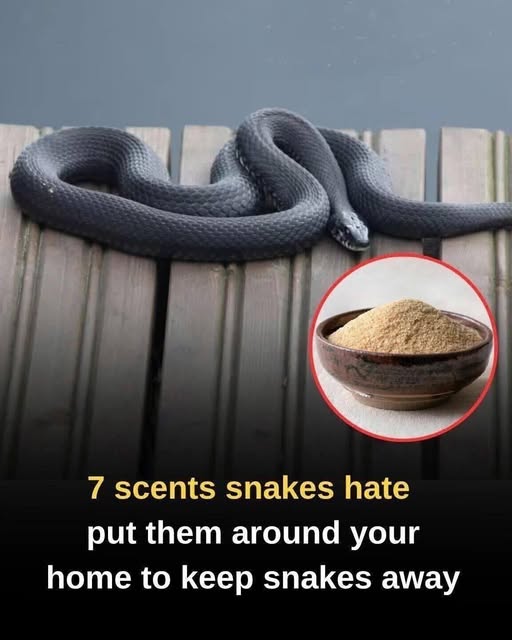
Snakes don’t knock before they arrive. They don’t rattle the gate or send a warning. One moment your yard feels ordinary and safe, and the next there’s a silent shape sliding along a fence line, beneath a porch, or across a warm stone path. They appear suddenly, quietly, and often far closer to your home than you ever imagined. That moment of realization can send a rush of panic through anyone. Your first instinct is simple and powerful: keep them away. But for many people, there’s also another thought—there has to be a way to do it without harming them. 🐍
That’s where the flood of advice begins. Friends, neighbors, and social media all seem to have their own secret solution. Some swear that ammonia drives snakes away instantly. Others insist garlic scattered around the yard works like an invisible fence. You might hear about vinegar, cinnamon oil, clove oil, citronella, or even planting certain flowers to keep reptiles at bay. The internet is full of confident claims, but the truth behind these remedies is more complicated—and far less magical—than the rumors suggest.
To understand what really works, it helps to understand how snakes experience the world. Unlike humans, snakes don’t rely heavily on sight or hearing to navigate their surroundings. Instead, their survival depends on chemistry. With every flick of their tongue, they gather tiny particles from the air and ground, delivering them to a specialized sensory organ that interprets the environment like a chemical map. Through this system they track prey, identify predators, and sense changes in their habitat. Because of this heightened sensitivity, powerful odors can sometimes disrupt their perception and make certain places temporarily unpleasant.
Take ammonia, for example. Its sharp, penetrating fumes can overwhelm a snake’s sensory system, making an area uncomfortable enough that the animal may choose to move on. Some homeowners place ammonia-soaked rags near outdoor structures, sheds, or crawl spaces in hopes of creating a chemical barrier. In theory, it can work for a short time. But there are serious limitations. Ammonia evaporates quickly, meaning the effect fades fast, especially outdoors. It can also pose risks to pets, wildlife, and people if used improperly. Because of this, it should never be used indoors or poured into the soil, and any use should be cautious and temporary. ⚠️
Essential oils are another commonly recommended approach. Oils such as cinnamon, clove, or even cedar are extremely potent to animals with sensitive chemical receptors. When diluted and sprayed along foundations, garden edges, or pathways, they can overstimulate a snake’s senses and encourage it to avoid the area. But like ammonia, their power is short-lived. Rain, sunlight, and humidity break down these scents quickly, sometimes within hours. A yard treated with oils today may lose most of its effectiveness after the next storm.
Other household items appear frequently in folk advice as well. Garlic and onions release sulfur compounds that produce strong odors. Vinegar’s acidity creates a sharp scent along surfaces like fences or stone pathways. Plants such as lemongrass, marigolds, and citronella are often promoted as natural snake repellents, partly because their fragrances affect insects and small animals that snakes feed on. While these methods may contribute small deterrent effects, none of them create a true barrier. Snakes can—and often do—simply move past them if food, shelter, or warmth waits on the other side.
The deeper truth is that snakes rarely enter human spaces randomly. They follow opportunity. A yard filled with hiding places, moisture, and prey becomes an invitation. Tall grass, piles of wood, cluttered sheds, and dense shrubs provide cool shelter. Bird feeders attract rodents, which in turn attract snakes. Leaky hoses or standing water bring frogs and insects. In other words, the real magnet isn’t your house—it’s the ecosystem forming around it.
Because of that, the most effective strategy isn’t a scent at all. It’s habitat management. Sealing small gaps around foundations, repairing vents, and closing openings beneath decks removes entry points. Keeping grass trimmed and clearing brush eliminates hiding spots. Storing firewood off the ground, reducing clutter, and managing moisture make the area less appealing for both snakes and their prey. When rodents disappear, snakes usually follow. 🏡
This approach doesn’t rely on fear or force. Instead, it gently shifts the environment so that snakes simply choose somewhere else to go. Used together, mild scent deterrents and smart property maintenance can encourage snakes to pass through your yard rather than settle in it.
And that balance matters. Snakes may startle us, but they play an essential role in nature. By controlling populations of rodents, insects, and other pests, they quietly protect gardens, crops, and ecosystems. Removing them entirely would create problems far bigger than the occasional surprise encounter.
So when a snake appears near your home, the goal doesn’t have to be destruction. With patience, awareness, and a few practical steps, you can create a space that feels safe for your family while still respecting the wildlife that shares the landscape. In most cases, the best outcome isn’t a battle at all—it’s simply a quiet decision by the snake to keep moving. 🌿🐍