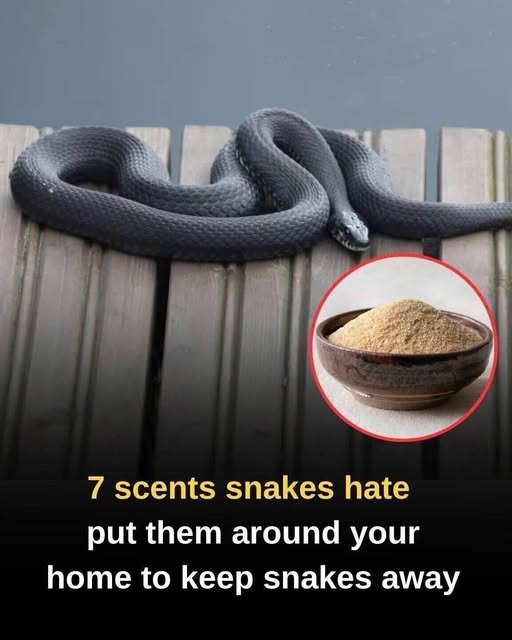
Snakes never announce themselves. They don’t scratch at the door or rustle loudly through the yard. They arrive quietly—gliding through grass, slipping beneath fences, appearing where you least expect them. One moment your home feels safe and ordinary. The next, your pulse jumps as a long shape moves across the patio or disappears into the shadows near your garden. 😨🐍
For many people, that moment sparks pure panic. Instinct screams to drive the snake away immediately. Yet most homeowners don’t actually want to harm the animal. They simply want it gone—and preferably never to return. That’s where a flood of advice begins circulating online and among neighbors: pour ammonia around the yard, scatter garlic cloves, spray essential oils, splash vinegar along the fence line. Some people swear these tricks work like invisible barriers. Others insist they do absolutely nothing.
The reality is more complicated—and more interesting—than either side usually admits.
How Snakes Experience the World
Snakes don’t rely on vision the way humans do. Their real superpower is chemical sensing. Every flick of a snake’s tongue collects microscopic scent particles from the air and ground. Those particles are analyzed through a specialized organ called the Jacobson’s organ, allowing the snake to detect prey, predators, and environmental cues with remarkable precision.
This means smells—especially strong or irritating ones—can influence where a snake chooses to move. If an area overwhelms its sensory system, the snake may avoid it. But “may avoid” is very different from “guaranteed repellent.” Nature rarely works that neatly.
The Strong-Smell Strategy
Some of the most commonly suggested snake deterrents rely on powerful odors.
Ammonia is often mentioned first. Its sharp fumes can irritate a snake’s sensory organs, making the environment unpleasant. In theory, placing ammonia-soaked cloths around entry points or outdoor corners may push a snake to move elsewhere. But ammonia evaporates quickly, especially in warm weather, which means its effect disappears fast. It also carries real risks—breathing the fumes can irritate humans and pets, and spills can damage plants or soil. For those reasons, it should only ever be used cautiously and strictly outdoors. ⚠️
Essential oils such as cinnamon oil and clove oil are another popular suggestion. These oils contain compounds that strongly stimulate sensory receptors in reptiles. When diluted and sprayed around foundations, garden edges, or pathways, they can create an area snakes might find irritating enough to avoid. The problem? Rain, humidity, and sunlight break down these scents quickly, often within days.
Natural Scents People Trust
Beyond harsh chemicals, many homeowners prefer plant-based approaches.
Garlic and onions release sulfur compounds that create strong odors in soil. Some gardeners believe these smells disrupt scent trails snakes use when hunting.
Vinegar is sometimes poured near water features or fence lines, where its acidic smell may temporarily discourage reptiles from lingering.
Certain plants also appear in many “snake-proof garden” lists.
- Lemongrass, which produces citronella-like oils
- Marigolds, known for their pungent roots
- Citronella plants, famous for their mosquito-repelling aroma
While these plants won’t create an invisible shield, they can contribute to an environment snakes find less appealing.
The Hidden Factor: Food
One of the biggest reasons snakes enter yards has nothing to do with smells at all—it’s food.
Rodents, insects, frogs, and lizards attract snakes because they represent easy meals. If your property hosts a steady buffet of prey, even the strongest scent barriers won’t matter much. The snake’s survival instincts will outweigh the irritation. 🐭
That’s why reducing prey populations is often far more effective than scattering repellents. Secure trash bins, remove birdseed that spills onto the ground, and eliminate hiding spots for mice.
The Real Long-Term Solution
Experts who study reptiles often emphasize something simpler and more reliable than any scent: habitat control.
Snakes seek three things—shelter, moisture, and food. Remove those, and your yard becomes far less attractive.
Key steps include:
- Sealing gaps under doors, fences, and foundations
- Removing piles of wood, rocks, or debris
- Keeping grass trimmed and shrubs maintained
- Draining standing water and fixing leaky irrigation
- Storing firewood away from the house
When these measures are combined with occasional scent deterrents, the effect becomes stronger. Instead of trying to “block” snakes, you’re quietly convincing them your property simply isn’t worth the trouble.
Why This Matters
It’s easy to see snakes only as threats, but they play an essential ecological role. Many species help control rodent populations that damage crops, spread disease, and invade homes. Killing snakes indiscriminately can disrupt local ecosystems and often leads to more pests—not fewer. 🌿
Encouraging snakes to pass through your area rather than settle there offers a balanced solution. You protect your home while allowing these reptiles to continue their work in the wild.
The Bottom Line
Rumors about snake repellents contain a grain of truth—but no miracle cure. Strong smells like ammonia, essential oils, garlic, or vinegar may temporarily discourage snakes, especially when used around entry points and pathways. Yet these scents fade quickly and cannot replace good yard maintenance.
Real protection comes from combining small strategies:
clean spaces, sealed gaps, controlled prey populations, and occasional scent deterrents.
Do that consistently, and most snakes will do exactly what you want them to do—slide quietly past your home and disappear back into the landscape where they belong. 🐍✨