
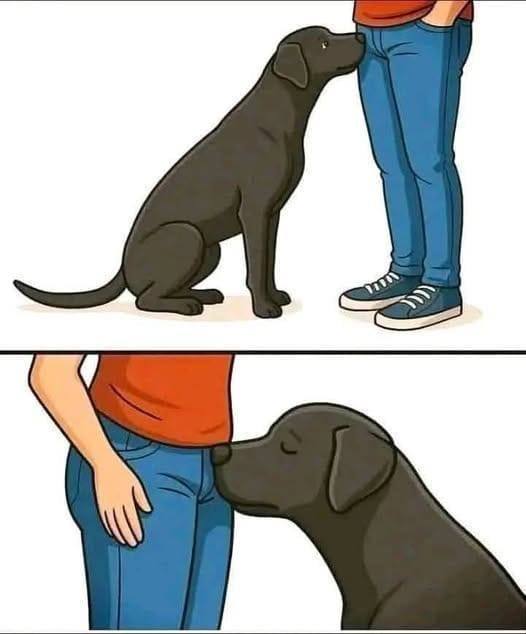
They never intend to embarrass you. 🐶
But the moment still feels like it lasts forever.
One second you’re welcoming a guest into your home—smiling, making small talk, maybe offering a drink. The next, your dog trots over with cheerful confidence and plants their nose directly where polite society says it absolutely should not go. Suddenly time slows down. Your guest stiffens. You freeze. And your dog, blissfully unaware of the social catastrophe unfolding, continues investigating as if nothing unusual is happening.
It feels awkward. It feels invasive. And for many owners, it can be downright mortifying.
But to your dog, this moment isn’t rude at all. It’s communication.
Dogs experience the world through scent in the same way humans experience it through sight and conversation. Their noses are astonishingly powerful—capable of detecting layers of information that we cannot even begin to perceive. While humans rely on facial expressions, words, and eye contact to introduce ourselves, dogs rely on scent. Every smell tells a story.
And the human body carries many of those stories in the form of pheromones—subtle chemical signals released naturally through the skin. These signals can reveal surprising details: age, biological sex, emotional state, stress levels, and even certain aspects of health. To a dog’s sensitive nose, those signals are like an introduction card filled with fascinating information.
The strongest concentrations of these scent signals are found in areas where sweat glands are most active—particularly around the armpits and genitals. So when a dog greets someone by heading straight for a crotch sniff, they’re not trying to be inappropriate. They’re simply going directly to the source of the richest information available.
In the canine world, this is the equivalent of saying, “Hello, nice to meet you. Tell me about yourself.” 🐾
It’s the same instinct that drives dogs to sniff each other’s rear ends when they meet. What seems bizarre or embarrassing to us is, for them, a perfectly normal and efficient exchange of information. In just a few seconds of sniffing, a dog can gather details that might take humans hours of conversation to uncover.
Still, understanding the behavior doesn’t necessarily make it any less awkward when it happens during a dinner party or family gathering.
The good news is that you don’t have to choose between respecting your dog’s instincts and maintaining social comfort. With patience and consistent training, you can gently guide your dog toward more polite greetings without confusing or punishing them.
Training works best when it redirects the behavior rather than suppressing it entirely. When your dog approaches a guest, simple commands like “sit,” “stay,” or “come” can help shift their focus. Rewarding calm behavior with treats, praise, or a quick pet reinforces the idea that polite greetings bring positive attention.
Over time, your dog begins to learn a new social script: greet the guest calmly, sit politely, receive praise.
Consistency is key. Dogs learn through repetition and positive reinforcement, so the more you practice these greetings with visitors, the more natural they become. Eventually, your dog will start offering the polite behavior automatically.
And something else changes too.
When you understand what your dog is actually doing in those awkward moments, the embarrassment begins to fade. Instead of seeing a social blunder, you start to see curiosity. Instead of misbehavior, you see communication.
That nose pressed into an awkward place isn’t meant to cause chaos—it’s simply your dog reading the world the only way they know how.
What once felt humiliating becomes a small reminder of how different—and how fascinating—the canine world really is. And with a little guidance, patience, and empathy, even the most awkward greeting can become another step toward a stronger bond between you and your four-legged companion. 🐕✨