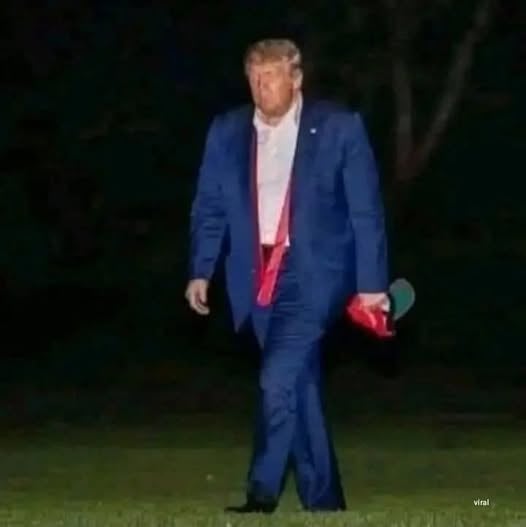
The silence of the street had a strange weight to it that night—thick, unmoving, the kind that makes even the faintest sound feel amplified. Then, just past midnight, that silence broke.
A shadow appeared beneath the pale glow of a streetlamp.
Witnesses say the figure moved slowly, almost deliberately, as if aware that every step might be noticed. He wore a simple baseball cap pulled low over his face, the brim casting a dark line across his features. For a moment, people weren’t even sure who they were looking at. Then the realization spread in hushed whispers.
It was Donald Trump.
There was no motorcade rumbling in the distance. No security detail pushing crowds aside. No flashing cameras or podium waiting nearby. Just a former president walking quietly through the night.
And in his hand was something small.
Witnesses noticed it immediately because of the way it caught the light. The object—whatever it was—glinted beneath the streetlights each time he shifted his grip. It wasn’t large enough to identify from a distance, yet it was just noticeable enough to ignite curiosity. Trump held it carefully, almost protectively, as he moved down the quiet street.
Within minutes, someone snapped a photo.
The image was far from perfect. Grainy. Slightly blurred. The cap obscured much of his face, and the object in his hand looked like nothing more than a vague metallic shape. But in the digital age, clarity isn’t always required for a story to explode.
By morning, the photograph was everywhere.
Online forums dissected every pixel. Social media users zoomed in, sharpened the image, circled the mysterious object with bright red outlines. Speculation spread like wildfire. Some insisted it was a phone. Others argued it looked like a key. A few went further, weaving elaborate theories about secret meetings, hidden messages, and late-night missions that existed only in imagination.
Theories multiplied faster than facts.
Comment sections turned into battlegrounds of interpretation. One group saw evidence of something profound and hidden. Another dismissed the entire scene as meaningless coincidence. News sites picked up the story not because answers had emerged—but because the questions themselves had become irresistible.
And through it all, one simple detail remained unchanged: no one actually knew what the object was.
What lingered after the frenzy wasn’t the object itself, but what the reaction revealed about us.
A quiet midnight walk had transformed into a national guessing game. A blurry photo became a canvas for millions of interpretations. In the absence of clear answers, people filled the silence with their own narratives—each shaped by personal beliefs, fears, hopes, or political loyalties.
For some, the image confirmed suspicions they already carried. For others, it became proof of how easily ordinary moments can spiral into spectacle.
The man in the baseball cap barely needed to do anything at all.
His mere presence—combined with the mystery of something small in his hand—was enough to ignite a storm of attention. It’s the strange gravity that surrounds powerful public figures: even the most mundane moment can feel like a clue in a puzzle that may not exist.
In today’s hyperconnected world, curiosity rarely stays quiet for long.
Every photograph becomes evidence. Every shadow becomes a question. And every unanswered detail invites a flood of theories racing to fill the void before reality has a chance to catch up.
The late-night sighting serves as a subtle reminder of how thin the line has become between curiosity and obsession. Public figures like Donald Trump live beneath a permanent magnifying glass, where even a private walk can transform into a viral mystery.
Yet the moment also carries a quieter truth.
Not every shadow hides a secret.
Not every unanswered question points to a conspiracy.
Sometimes, the only thing truly revealed is how quickly we project meaning onto the unknown.
And sometimes, when we stare long enough at a blurry image in the dark, what we end up seeing most clearly is ourselves. 👀🌙📸