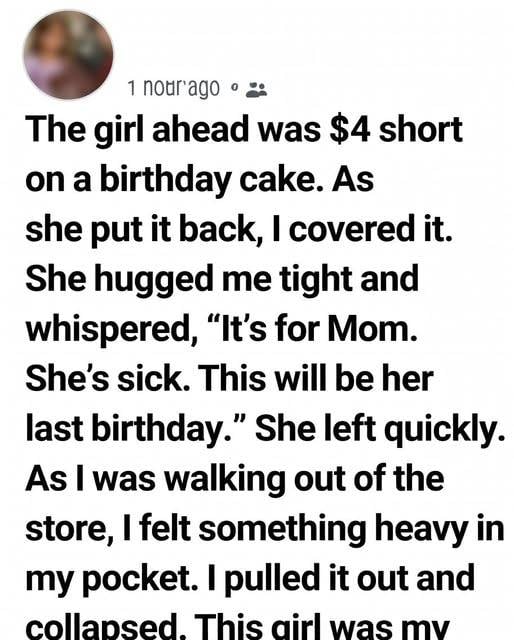
The grocery store was unusually quiet that afternoon, the kind of quiet that presses in around you, making every small sound seem amplified—the rustle of a shopping bag, the soft hum of the fluorescent lights overhead. She stood there, a small girl no older than ten, her hands wrapped around a tiny, modest cake. Not enough money. Not nearly enough. And yet she lingered, eyes wide and anxious, carrying a weight far too heavy for anyone her age. Her uncertainty radiated from her in small, almost imperceptible waves—a surrender, gentle but profound, that spoke louder than any words could.
I froze for a moment, watching her wrestle with the impossible choice: leave the cake behind or step forward and risk the embarrassment, the rejection, the judgment of the world in a single, quiet instant. The air around us seemed to thicken, charged with something fragile and real, like the tension right before a storm breaks. One heartbeat, one choice, and the moment stretched out as though time itself had paused, waiting for someone to act.
When the cashier finally slid the cake back toward her, something in me shifted. It wasn’t about heroism or earning praise, wasn’t a lesson in generosity or moral duty. It was simpler, subtler, but infinitely more powerful: it was the realization that, for this brief, fleeting moment, I could be the bridge between despair and hope. The weight on her small shoulders softened immediately. She looked up at me, eyes shining, and threw herself into a quick, desperate hug—not just for the comfort of a stranger’s kindness, but for something deeper, something unspoken that she needed to hold onto.
“I—I need it for my mom,” she whispered, her voice trembling, and suddenly the cake was no longer a simple dessert. It became something alive, something sacred: a flicker of hope, a thread of warmth in a world that had been unkind to her. In that moment, the mundane fluorescent-lit aisles of the grocery store became a sanctuary, a place where one ordinary decision quietly altered the course of a life.
Later, when I found the small note she had slipped into my pocket—careful, almost timid handwriting, a single crooked candle drawn above the sketch of her lopsided cake—I felt a lump rise in my throat. I still keep that note in my wallet, where I see it every day. It reminds me of a truth that often goes unnoticed: the most profound turning points in life rarely arrive with fanfare or spectacle. They come quietly, in ordinary spaces—a checkout line, a small child, a decision that anyone could make but not everyone dares to.
It is in that narrow, fleeting space that kindness wields its quiet power, rewriting what a day, or even a life, might become. One small gesture can ripple outward in ways we cannot measure, leaving behind a story of hope and connection that lasts far longer than the moment itself. And sometimes, just sometimes, all it takes is a little cake, a whisper, and the courage to act.