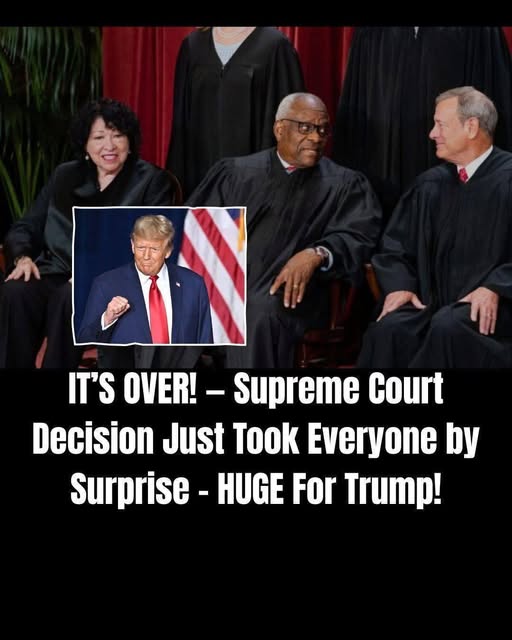
A seismic legal shift just shook the heart of Washington. In a decisive 8–1 ruling, the Supreme Court handed former President Donald Trump a sweeping victory on immigration — a decision that instantly reshapes the lives of hundreds of thousands of Venezuelans living in the United States. Families who had believed they were secure, whose daily routines were punctuated by school runs, work commutes, and soccer practices, now face a nightmare scenario: the fragile sense of safety they had built may have vanished overnight. Homes, jobs, and futures are suddenly suspended in uncertainty, their stability threatened by the stroke of a pen.
The ruling did far more than resolve a technical debate over Temporary Protected Status (TPS); it fundamentally redefined the balance between compassion and control in U.S. immigration policy. By declaring that TPS is a tool of foreign policy rather than a lasting sanctuary for vulnerable people, the Court has given the White House unprecedented authority over the fate of migrants whose lives have already been defined by upheaval. For Venezuelans who have spent years working tirelessly, paying taxes, and raising children born on American soil, the decision delivers a brutal message: your presence here was never guaranteed, and that precarious permission has now been called into question.
Across the Department of Homeland Security, signals of a tougher stance are already emerging under the leadership of Kristi Noem. The political debate is intensifying. Supporters hail the ruling as a necessary restoration of presidential authority, arguing that discretion in mercy cannot quietly become permanence. Critics, meanwhile, see a chilling exercise of legalism, one that overlooks the human stakes: the terror of a knock on the door, the heartbreak of forced separation, the looming possibility of being sent back to a country rife with chaos, violence, and economic collapse.
Caught in the widening gap between law and lived reality, hundreds of thousands of Venezuelans now hover in a painful limbo. They are tethered between the country they once fled and a nation that may no longer be willing to embrace them. Each day brings more uncertainty: employers wonder if their workers will stay, schools wonder if children will return, and families confront the unthinkable — that the security they had long taken for granted may have been a temporary illusion. The Supreme Court’s ruling did not merely redraw the lines of immigration law; it sent a shockwave through human lives, a stark reminder that legality and mercy often march on separate paths.