Airports never truly closed during the longest shutdown in modern American history—but something inside the system began to crack. Terminals still buzzed with rolling suitcases, departure boards still flickered with destinations, and planes continued to lift into the sky. Yet beneath that familiar rhythm, a quieter crisis was unfolding. The people responsible for keeping travelers safe—the officers of the Transportation Security Administration—were showing up to work every day without pay.
They stood at their posts scanning bags, checking IDs, and managing restless crowds while their own bank accounts sat frozen. Mortgage payments didn’t pause. Grocery bills didn’t disappear. For thousands of security officers, every shift meant protecting the nation’s airports while wondering how long their families could hold on.
And the pressure showed.
Lines grew longer. Patience grew shorter. Frustration began to ripple through terminals from coast to coast. At major hubs like Hartsfield‑Jackson Atlanta International Airport and John F. Kennedy International Airport, travelers shuffled forward inch by inch, watching the clock and hoping they wouldn’t miss their flights. Officers called in sick more often. Some simply couldn’t afford the commute anymore. The system didn’t collapse—but it bent under the weight of uncertainty.
Passengers felt the strain in ways that were difficult to quantify. A line that should have taken ten minutes stretched into forty. Security lanes opened and closed unpredictably as staffing fluctuated. Tempers flared, apologies echoed, and no one could give a clear answer about when normalcy would return.
Still, most officers stayed.
They came back day after day not because the system was functioning smoothly—but because they refused to abandon it. The quiet resilience of ordinary workers kept the country’s air travel network from unraveling entirely.
Meanwhile, the people responsible for ending the shutdown moved through airports very differently.
Members of United States Congress often traveled with a privilege few passengers ever saw. Escorts guided them through security. Special lanes allowed them to bypass the crowds. The chaos unfolding in the terminal rarely touched them directly. The distance between decision-makers and the consequences of those decisions remained comfortably wide.
Until one airline decided to close that gap.
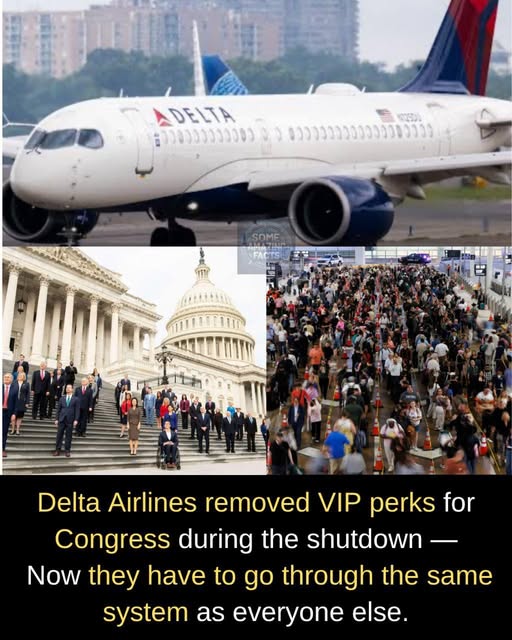
Without fanfare or a dramatic announcement, Delta Air Lines quietly removed the special assistance that had smoothed the journey for lawmakers. The VIP shortcuts disappeared. The backdoor pathways through security were gone.
Suddenly, a senator or representative arriving at the airport faced the same reality as everyone else: the same crowded lines, the same anxious glances at departure screens, the same uncertainty about how long the wait would last.
Officially, the explanation was simple—resources were stretched thin during the shutdown, and special accommodations could no longer be justified. But the effect was far more symbolic than logistical.
For the first time in weeks, the people who had the power to end the crisis were standing inside the very system it had strained.
They shuffled forward with carry-ons in hand. They heard the same complaints from tired travelers. They watched the same overworked officers trying to keep the lines moving. The buffer that once separated policymakers from the public had quietly vanished.
No speeches were made. No legislation was suddenly announced in the terminal. But something subtle changed.
In those slow-moving security lines, the divide between authority and everyday experience narrowed—if only for a moment. Power wasn’t insulated behind private corridors or escorted gates. It was waiting, just like everyone else, under the fluorescent lights of an airport checkpoint.
And in that shared inconvenience came a sharp, uncomfortable clarity: systems are easy to manage from a distance. They feel very different when you’re standing inside them. ✈️⏳