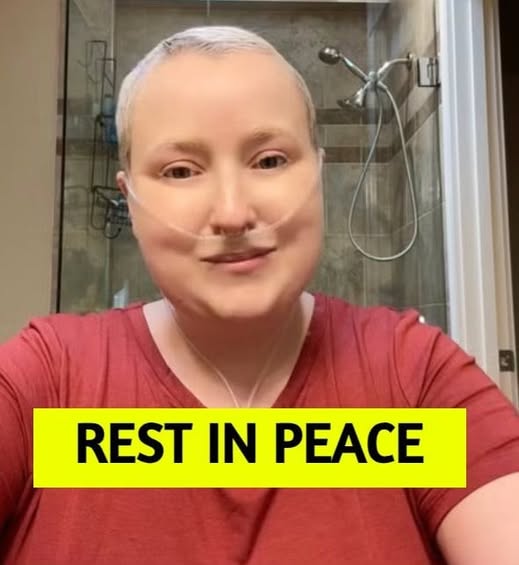
Her final nine minutes felt less like a farewell and more like a quiet earthquake that rippled across millions of screens. In that brief span of time, a young doctor—someone who had spent years delivering devastating diagnoses to others—turned the camera toward herself and spoke the words no one ever imagines saying about their own life.
Dr. Kimberly Nix, a 28-year-old oncologist, had spent her career guiding patients and families through the terrifying maze of cancer. She knew the vocabulary of hope and heartbreak better than most. She knew how to pause before saying the hardest words, how to steady a trembling hand across a desk, how to help someone breathe through the moment their world changed.
But this time, there was no desk between her and the truth.
Looking directly into the camera, she shared the reality she had once helped others face: metastatic sarcoma, aggressive and relentless. The treatments had been exhausted. The options had run out. There would be no new trial waiting in the wings, no miracle therapy around the corner. The horizon, she explained with remarkable clarity, had grown painfully short.
And yet, what stunned people most was not the diagnosis. It was her calm.
There was fear in her eyes—of course there was. She was 28 years old, standing at the edge of a future she had barely begun to build. But woven through that fear was something stronger and steadier: courage. Not the loud, dramatic kind often celebrated in movies, but a quiet, deliberate courage that refused to look away from reality.
Her voice never begged for more time.
Instead, it reached outward.
She spoke to strangers she would never meet, to people scrolling through their phones late at night, to future patients who might one day sit in the same chairs she had once stood beside as a doctor. She spoke about the small, ordinary things that suddenly mattered more than anything: laughter with friends, a swipe of lipstick before recording a video, moments of lightness that pushed back against the growing darkness.
For months leading up to that final video, Dr. Nix had been documenting her journey online. But her posts were never about tragedy alone. They were about honesty. Some days she shared humor, cracking jokes about hospital life or the strange absurdities of illness. Other days she allowed viewers to witness the vulnerability of living with a disease she understood all too well.
What made her voice so powerful was that she spoke from both sides of the medical world.
She was not just a patient learning the language of cancer—she had once been the translator. She had sat in rooms where hope flickered and sometimes faded. She had watched families wrestle with impossible decisions. She knew exactly what those moments felt like because she had helped carry people through them.
Now, she was the one living inside that reality.
Yet she refused to let her story shrink into despair.
Instead, she treated her time like a lantern. Every video, every message, every honest confession became a small light for others navigating the same terrifying road. She didn’t pretend everything was okay. She didn’t disguise the pain or the uncertainty. But she showed something equally powerful: that even when life narrows, meaning can still widen.
In those final minutes, as her voice softened and the weight of goodbye settled into the room, she made one last request.
It wasn’t about remembering her.
It wasn’t about sympathy.
It was about action.
She asked people to donate to the Sarcoma Alliance, an organization dedicated to supporting patients and advancing research for the rare cancer that had claimed her future. If her story moved people, she said, then let it move them to help someone else. Let it push the odds—just a little—in favor of the next person diagnosed.
It was a simple request, but also an extraordinary one.
Because in that moment, Dr. Kimberly Nix was doing what she had always done as a physician: thinking about the patient who would come after her.
She understood that she could not rewrite her own ending. The disease had already taken that power away. But she could still influence what came next for someone else. She could still transform her final chapter into a bridge toward another person’s beginning.
And that is why those nine minutes struck so deeply.
They were not simply a goodbye from a young doctor facing the unimaginable. They were a reminder that courage does not always look like fighting until the last second. Sometimes it looks like generosity in the face of loss. Sometimes it looks like a person choosing to turn their final moments into a gift for strangers.
Dr. Kimberly Nix never asked the world to remember her name.
She only asked that her ending might help someone else keep living their story a little longer. 💔✨